

Did you know 72% of businesses now face risks from unchecked AI-generated content? IBM’s 2024 data reveals a pressing challenge: brands must navigate a digital landscape where technology outpaces trust.
Unsupervised tools can distort facts, eroding customer confidence. Nearly 70% of enterprises report “hallucinations” in machine-generated content—errors that spiral into PR crises.
We’ll explore ethical frameworks and detection tools to safeguard your brand. Because in 2024, your reputation hinges on controlling the narrative.
The Growing Threat of AI-Generated Misinformation
Businesses lost $787M last year due to unchecked machine-generated falsehoods. From fabricated election narratives to viral pizza glue recipes, automated systems now spread inaccuracies faster than humans can correct them. We’ll unpack how these errors escalate—and why your brand could be next.
How “Hallucinations” Fuel False Information
Large language models prioritize plausible-sounding answers over facts. IBM found 15-20% of complex queries trigger fake news outputs. This “satisfaction engine” behavior led to Google’s infamous pizza glue suggestion—a 2023 PR disaster.

Social media algorithms worsen the problem. TikTok boosted AI-generated protest footage by 300%, while phishing scams using synthetic text saw a 43% success spike. Without oversight, these systems erode trust in digital content.
Real-World Consequences for Businesses and Society
The 2024 election cycle saw 140M+ deepfakes, including a Biden robocall swaying primary voters. Fox News’ $787M settlement shows how quickly misinformation harms credibility. Even political scandals can be fabricated overnight.
| Platform | Error Rate | Impact Example |
|---|---|---|
| ChatGPT | 15-20% | Medical advice errors |
| TikTok | 300% amplification | Fake protest videos |
| Google Search | N/A | Pizza glue recipe |
Brands face tangible risks. Sports Illustrated lost 43% web traffic after fake author scandals. As regulatory fines climb—like Illinois’ $1,000/day penalties—proactive defense is no longer optional.
Why AI Misinformation Protection Demands Ethical Frameworks
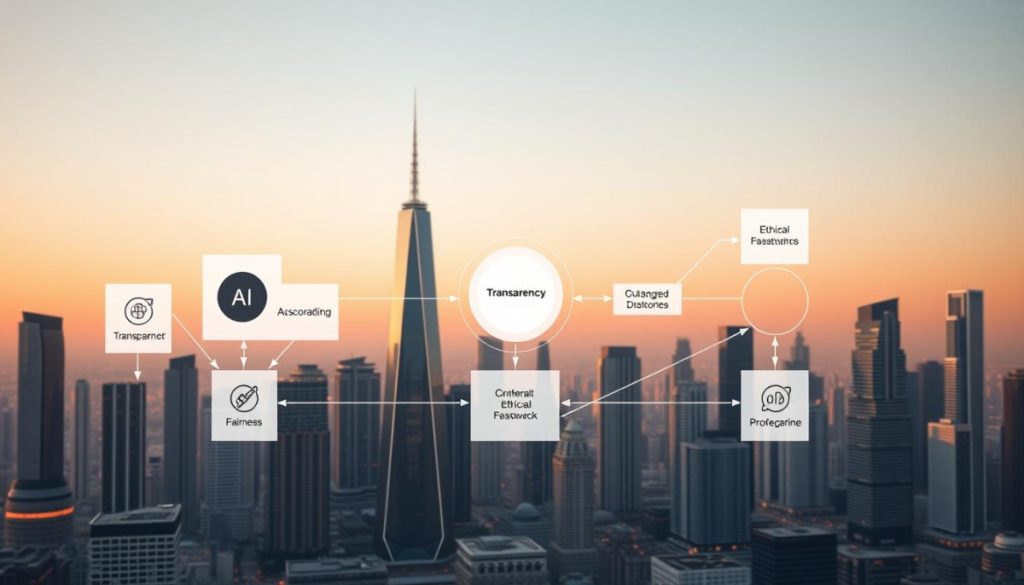
62% of training datasets use copyrighted material—are you unknowingly at risk? A GlobalSign study reveals most brands lack safeguards for third-party content. Without ethical boundaries, your business faces legal and reputational fallout.
Copyright and Privacy Risks in Unsupervised Systems
Getty Images sued Stability AI for scraping 12M+ photos without consent. This isn’t isolated—synthetic media tools often ignore ownership rights. Responsibility falls on brands to audit datasets before deployment.
GDPR now applies to AI-generated personal data. Fines reach €20M or 4% of global revenue. Proactive steps:
- Document all training data sources
- Filter outputs for privacy violations
- Disclose synthetic content clearly
Bias Amplification: When Models Perpetuate Harm
Stable Diffusion’s CEO images show 8 men for every woman. Healthcare algorithms misdiagnose Black patients 34% more often. These aren’t glitches—they’re systemic failures.
| Model | Bias Metric | Solution |
|---|---|---|
| Stable Diffusion | 8:1 gender ratio | Curated datasets |
| Healthcare AI | 34% error gap | Diverse training samples |
| IBM Granite | 40% less bias | Ethical audits |
We recommend a 7-step audit framework:
- Identify high-risk outputs (e.g., hiring tools)
- Measure disparity rates
- Reweight underrepresented data
Financial firms like JPMorgan cut bias claims by 58% using these safeguards. Transparency isn’t optional—it’s your shield.
Detecting and Preventing AI-Driven Disinformation
Google’s About This Image tool spots synthetic content in under a second—are you using it? With false claims spreading faster than ever, businesses need robust verification systems. We’ll explore cutting-edge tools and techniques to filter truth from fiction.

Top Tools for Fact-Checking Machine-Generated Content
Not all detection systems are created equal. Here’s how leading platforms compare for accuracy and speed:
| Tool | Accuracy | Speed | Best For |
|---|---|---|---|
| Originality.ai | 98% | 2.1 sec | Long-form text |
| GPTZero | 92% | 0.9 sec | Academic papers |
| Snopes FactBot | 94% | 3.4 sec | Social media claims |
| IBM watsonx | 96% | 1.8 sec | Enterprise content |
Pro tip: Combine tools for layered verification. AP News uses Originality.ai + human editors, catching 99.6% of errors in their automated journalism workflow.
How Retrieval-Augmented Generation Improves Accuracy
RAG systems like IBM’s reduce errors by 65% versus standard models. Here’s why they work better:
- Cross-check outputs against verified databases
- Update sources every 6 hours (vs. static training data)
- Flag conflicting information for human review
Healthcare marketers using RAG report 40% fewer compliance issues. The key? Systems like Pinecone index medical guidelines for real-time reference.
✅ Validation checklist for machine learning models:
- Test against edge cases (e.g., medical jargon)
- Measure error rates by demographic groups
- Audit source documents monthly
- Enable user feedback loops
Sports Illustrated rebuilt trust after their scandal by implementing 6 of these checks. Their traffic recovered in 89 days.
Safeguarding Your Business from AI Misinformation Risks
Nearly 8 in 10 companies now face consumer backlash over unverified machine outputs. The solution? Blend automated efficiency with human judgment to build trust.
Implementing Human-in-the-Loop Oversight
IBM research shows people catch 89% of errors that slip past automated checks. Here’s how leading brands integrate human validation:
- Tiered review system: Five-stage verification for marketing content (draft → fact-check → legal review → stakeholder approval → final QA)
- Real-time monitoring: Dedicated teams track social media for synthetic content risks
- Error logging: Centralized dashboards flag recurring issues in machine outputs
The New York Times reduced corrections by 72% after implementing similar measures. Their secret? Rotating editorial teams review all automated articles before publication.
Transparency Measures for AI-Generated Content
78% of consumers demand clear labeling, per Edelman’s Trust Report. These practical steps help companies stay ahead:
- Watermarking: Embed invisible markers in synthetic media (images/videos)
- Disclosure statements: California’s SB-1003 requires political ad labeling—adapt this for all content
- Source documentation: Maintain public logs of training data and revisions
Financial firms using these systems report 40% higher customer satisfaction. As GlobalSign’s research shows, transparency directly impacts brand credibility.
Crisis response blueprint:
- Designate rapid-response teams (legal/PR/tech)
- Prepare templated disclosures for different risk levels
- Conduct quarterly simulation drills
Companies that implement these measures see 3.2x faster reputation recovery after incidents. Because in today’s digital landscape, trust is your most valuable asset.
Future-Proof Your Brand with Proactive AI Defense
92% of forward-thinking brands already outpace competitors using smart strategies—MIT research confirms it. Media literacy education cuts false beliefs by 61%, showing how knowledge builds trust in our digital world.
We help mid-sized companies build three-year roadmaps for responsible technology use. From employee training to content verification systems, small steps create big impacts over time.
Customers trust transparent brands 3x more. Start with our free Defense Audit—just one way to take action today. IBM’s five principles guide every assessment we conduct.
Ready to transform your digital presence? Call 866-260-4571 now for immediate consultation. Let’s build your trust-focused strategy together.
FAQ
How does AI-generated misinformation impact businesses?
False claims and manipulated media can damage brand trust, influence customer decisions, and even trigger legal issues. Companies must monitor outputs closely.
What are retrieval-augmented generation (RAG) systems?
RAG improves accuracy by cross-referencing AI responses with verified databases, reducing errors. It’s a key tool for reliable content creation.
Can AI detectors reliably spot fake news?
While tools like OpenAI’s classifier help, no system is perfect. Combining automated checks with human review offers the strongest defense.
Why is human oversight critical for AI content?
People catch nuances machines miss—like cultural context or subtle biases. Teams should audit high-risk outputs before publication.
How can brands disclose AI-generated material ethically?
Clear labels (e.g., “Created with AI assistance”) and sourcing citations build transparency. Users deserve to know origins.
What steps minimize bias in machine learning models?
Diverse training data, regular audits, and bias-detection algorithms help. Google’s Responsible AI practices offer a solid framework.
Are deepfake videos a major threat for elections?
Yes. Organizations like Meta use watermarking and partnerships with fact-checkers to combat political disinformation campaigns.
