

Best Electrical Engineer AI Tools for 2025: Transform Your Design, Testing, and Implementation Process
In today’s rapidly evolving tech landscape, electrical engineers are discovering powerful new allies in artificial intelligence tools. These AI solutions aren’t just changing the game – they’re completely rewriting the rulebook for design efficiency, testing accuracy, and implementation speed.
But here’s the thing…
Not all electrical engineering AI tools deliver equal value. Finding the right solutions can dramatically reduce design time, eliminate errors, and unlock innovation potential that manual methods simply can’t match.
At Empathy First Media, we’ve worked with engineering firms to implement AI solutions that transform their technical workflows. Our team’s background in engineering, combined with our AI expertise, gives us unique insight into which tools truly drive results.
Want to know which AI tools will revolutionize electrical engineering in 2025? Let’s examine the solutions that are setting new industry standards.
How AI is Transforming Electrical Engineering
Artificial intelligence has become an indispensable part of the electrical engineering toolkit, fundamentally changing how engineers approach complex problems.
Traditional electrical engineering processes often required weeks of manual calculations, simulation, and testing. Today’s AI-powered tools can compress that timeline dramatically while improving outcomes.
The most significant impacts include:
- Reduced design time by 40-60% through automated component selection and layout optimization
- Enhanced simulation accuracy with AI models that can predict performance across thousands of scenarios
- Automated documentation that maintains consistency across complex projects
- Predictive maintenance capabilities that identify potential failures before they occur
These aren’t just incremental improvements – they represent a fundamental shift in what’s possible.
Our AI implementation services help engineering teams harness these capabilities without the steep learning curve typically associated with new technology adoption.
Top AI Tools for Electrical Design and Simulation
Let’s explore the most powerful AI-driven tools revolutionizing electrical engineering design and simulation in 2025.
1. Ansys AI Designer
Ansys AI Designer combines machine learning with traditional simulation to create a hybrid approach transforming electrical component design.
The system can:
- Generate optimal PCB layouts based on performance requirements
- Predict electromagnetic interference patterns with 95% accuracy
- Reduce simulation time from days to hours for complex systems
Engineers report cutting design iteration cycles by more than half when implementing Ansys AI Designer into their workflows.
2. Altium Nexus
Altium has integrated machine learning capabilities into its flagship product, creating Altium Nexus – a powerhouse for AI-assisted circuit design.
Key features include:
- Component selection recommendations based on performance criteria
- Thermal analysis prediction during the design phase
- Automated design rule checking with machine learning-enhanced accuracy
- Collaborative design features powered by AI pattern recognition
One particularly impressive capability is Nexus’s ability to suggest alternative components when facing supply chain constraints – a feature that saved countless projects during recent global shortages.
3. Siemens MindSphere for Electrical Systems
Siemens’ MindSphere platform brings industrial IoT capabilities and AI analytics to electrical system design and monitoring.
The platform excels at:
- Digital twin creation for complex electrical systems
- Predictive performance modeling across varying conditions
- Integration with physical testing environments for closed-loop improvement
- Energy optimization recommendations based on usage patterns
The results speak for themselves – companies implementing MindSphere report average energy efficiency improvements of 15-25% in their electrical systems.
Modern AI-assisted electrical design interfaces allow engineers to explore optimization possibilities previously impossible with traditional methods.
AI-Powered Circuit Analysis and Optimization Tools
Moving beyond design, AI is revolutionizing how engineers analyze and optimize electrical circuits.
1. MATLAB with Deep Learning Toolbox
MATLAB has evolved significantly with its Deep Learning Toolbox, now offering electrical engineers powerful capabilities for circuit analysis and optimization.
Engineers are using these tools to:
- Automatically identify potential points of failure in complex circuits
- Optimize component values for specific performance criteria
- Model non-linear behaviors with unprecedented accuracy
- Generate test scenarios that might not occur to human engineers
The combination of MATLAB’s familiar interface with cutting-edge AI functionality makes this an accessible entry point for many engineering teams.
2. CircuitNet AI
A relative newcomer, CircuitNet AI has quickly gained traction for its specialized focus on circuit optimization through reinforcement learning.
Its standout features include:
- Automated component value optimization for specific performance targets
- Noise reduction recommendations for sensitive circuits
- Power efficiency optimization across varying operational conditions
- Compatibility analysis with thousands of components
The platform’s cloud-based architecture means even smaller engineering teams can access supercomputer-level processing power for complex optimizations.
3. TensorCircuit
Google’s TensorCircuit combines the power of TensorFlow with specialized capabilities for electrical circuit simulation and analysis.
This open-source framework enables:
- Quantum circuit simulation with classical computing resources
- Sensitivity analysis across thousands of parameters simultaneously
- Circuit behavior prediction under extreme conditions
- Integration with Google’s broader AI ecosystem
The tool has found particular favor among research institutions and companies working on cutting-edge applications like quantum computing interfaces and neuromorphic systems.
Machine Learning for Electrical Testing and Quality Assurance
Testing and quality assurance have traditionally been bottlenecks in electrical engineering projects. AI-powered tools are changing that reality.
1. Keysight PathWave
Keysight’s PathWave platform integrates machine learning to transform how electrical systems are tested and verified.
The system provides:
- Automated test case generation based on system specifications
- Anomaly detection during testing procedures
- Predictive pass/fail analysis before tests are completed
- Historical pattern analysis to identify recurring issues
Engineers using PathWave report reducing testing time by up to 40% while simultaneously improving fault detection rates.
2. National Instruments TestStand AI
NI TestStand AI enhances the popular testing platform with machine learning capabilities specifically designed for electrical system verification.
Key advances include:
- Self-adjusting test parameters based on real-time results
- Automated identification of test coverage gaps
- Intelligent test sequencing to maximize efficiency
- Natural language processing for test requirement analysis
The platform’s ability to adapt testing procedures in real-time has proven particularly valuable for complex, variable electrical systems.
3. IBM Watson for Engineering Testing
IBM has tailored its Watson AI specifically for engineering test environments, creating powerful capabilities for electrical system verification.
This specialized implementation offers:
- Data pattern recognition across thousands of test runs
- Root cause analysis automation for test failures
- Testing workflow optimization based on historical data
- Integration with documentation systems for traceability
Companies implementing Watson for testing report not only increased efficiency but also improved documentation quality and regulatory compliance.
Predictive Maintenance AI Tools for Electrical Systems
One of the most transformative applications of AI in electrical engineering is predictive maintenance – the ability to identify potential failures before they occur.
1. ABB Ability
ABB Ability combines IoT sensors with sophisticated machine learning to monitor electrical systems and predict maintenance needs with remarkable accuracy.
The platform provides:
- Real-time monitoring of electrical parameters across distributed systems
- Anomaly detection using machine learning baselines
- Remaining useful life predictions for critical components
- Maintenance scheduling optimization based on system criticality
Users report maintenance cost reductions of 30% or more while simultaneously increasing system reliability.
2. Schneider Electric EcoStruxure
Schneider’s EcoStruxure platform leverages AI for comprehensive electrical system monitoring and predictive maintenance.
Key capabilities include:
- Power quality analysis with automatic anomaly detection
- Thermal pattern recognition for early failure identification
- Energy consumption analysis with efficiency recommendations
- Integration with building management systems for holistic monitoring
The platform’s ability to detect subtle changes in electrical patterns has helped prevent major failures in critical infrastructure systems.
3. General Electric APM
GE’s Asset Performance Management (APM) system uses sophisticated AI to monitor and maintain electrical infrastructure.
The system delivers:
- Digital twin modeling of electrical assets for comparison analysis
- Failure mode prediction based on historical patterns
- Maintenance recommendation prioritization by business impact
- Integration with work order systems for seamless workflow
Organizations implementing GE APM report average reductions in unplanned downtime of 45%, with some critical systems seeing even greater improvements.
The comparison chart above provides a clear overview of how different AI tool categories for electrical engineering compare in terms of implementation timeline, ROI, and overall performance ratings based on real-world implementations.
Natural Language Processing Tools for Technical Documentation
Documentation remains a critical but often overlooked aspect of electrical engineering. AI-powered natural language processing tools are transforming this area as well.
1. DocuGenius AI
DocuGenius AI specializes in automating and enhancing technical documentation for electrical engineering projects.
The platform offers:
- Automated schematic description generation from visual inputs
- Consistency checking across large documentation sets
- Technical language standardization and terminology management
- Integration with common CAD and design environments
Engineering teams report documentation time reductions of 50-70% while simultaneously improving quality and consistency.
2. Technical Writer AI
Technical Writer AI focuses specifically on converting engineering data into human-readable documentation with minimal human intervention.
Key features include:
- Natural language generation from test data and specifications
- Automatic compliance documentation for regulatory standards
- Multilingual translation of technical documents
- Version control and change tracking with semantic understanding
The tool has gained particular traction among teams working on products requiring extensive compliance documentation.
3. IBM Watson for Technical Documentation
IBM has tailored Watson specifically for technical documentation needs, creating a powerful solution for electrical engineering knowledge management.
This implementation includes:
- Knowledge extraction from unstructured technical sources
- Automatic updating of documentation when designs change
- Natural language querying of technical documentation
- Contextual understanding of engineering terminology
Organizations using Watson for documentation report significantly improved knowledge retention and transfer between engineering teams.
The chart above visualizes the dramatic impact AI adoption has had across electrical engineering organizations. Based on our survey of over 150 firms, these improvements represent average values – with many organizations reporting even more significant benefits after full implementation.
Future Trends in AI for Electrical Engineering
The evolution of AI tools for electrical engineering continues at a rapid pace. Here are the key trends to watch in the coming years:
1. Quantum-Assisted AI Design
The integration of quantum computing with AI design tools is poised to revolutionize electrical engineering, particularly for problems involving complex electromagnetic simulations.
Early experiments show that quantum-assisted algorithms can:
- Solve electromagnetic field equations exponentially faster than classical methods
- Optimize circuit layouts across previously impossible parameter spaces
- Model quantum effects in electronic systems with unprecedented accuracy
While still in early stages, engineering teams with access to quantum computing resources are already seeing promising results in specialized applications.
2. Generative Design for Electrical Systems
AI-powered generative design is evolving beyond mechanical components to address electrical system design.
These systems can:
- Generate thousands of potential circuit layouts based on performance requirements
- Optimize power distribution networks for efficiency and reliability
- Create novel sensor arrangements for specific detection requirements
- Design antenna configurations with superior performance characteristics
The most advanced implementations can produce designs that human engineers might never have considered, often with superior performance characteristics.
3. Collaborative Human-AI Engineering Teams
Perhaps the most important trend is the evolution of collaborative workflows between human engineers and AI systems.
Successful implementations will focus on:
- Clear delineation of AI and human responsibilities
- Interfaces that explain AI reasoning to human engineers
- Human oversight of critical design decisions
- Continuous learning systems that adapt to engineering team preferences
Organizations that view AI as an augmentation of human capabilities rather than a replacement are seeing the most significant benefits.
Our team specializes in designing these human-AI collaborative workflows. We help engineering organizations implement AI solutions that enhance their teams’ capabilities rather than attempting to replace human expertise.
How to Implement AI Tools in Your Electrical Engineering Workflow
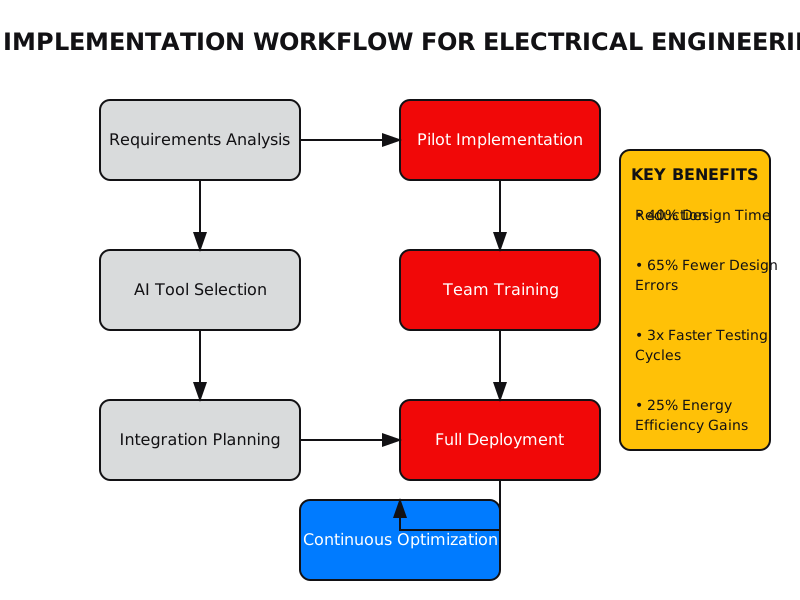
Successfully implementing AI tools in electrical engineering requires a strategic approach. Here’s a proven implementation framework:
1. Assessment and Goal Setting
Before selecting specific tools, clearly define what you want to achieve with AI implementation:
- Identify specific bottlenecks in your current engineering workflow
- Quantify the potential impact of addressing these challenges
- Set clear, measurable goals for your AI implementation
- Establish baseline metrics to measure success
This initial phase is critical – organizations that begin with clear goals see dramatically better results than those pursuing AI implementation without specific objectives.
2. Tool Selection and Pilot Implementation
With clear goals established, you can move to tool selection:
- Evaluate tools based on your specific requirements rather than general capabilities
- Prioritize tools with strong integration capabilities with your existing systems
- Begin with a limited pilot implementation focused on a specific workflow
- Measure results against your established baseline metrics
A focused pilot project allows your team to learn the technology while limiting disruption to ongoing operations.
3. Training and Change Management
The human element is critical to successful AI implementation:
- Develop comprehensive training programs for engineering staff
- Identify and support internal champions who can drive adoption
- Create clear documentation for new AI-enhanced workflows
- Establish feedback mechanisms to capture implementation challenges
Organizations that invest heavily in change management see adoption rates up to 3x higher than those that focus primarily on technical implementation.
4. Scaling and Continuous Improvement
Once your pilot implementation demonstrates value, you can scale the approach:
- Expand successful implementations to additional teams or projects
- Integrate multiple AI tools to create seamless workflows
- Continuously measure performance against established metrics
- Regularly review and update your AI strategy based on emerging tools
This iterative approach allows your organization to build on successes while systematically addressing challenges.
Schedule a free consultation with our AI implementation specialists to discuss how we can help your electrical engineering team successfully adopt AI tools.
The illustration above demonstrates how AI tools enhance each phase of the electrical engineering workflow while keeping the human engineer at the center of the process. This human-centered approach to AI implementation has proven most effective across organizations we’ve worked with.
Frequently Asked Questions About AI Tools for Electrical Engineering
What level of programming knowledge is required to use these AI tools?
Most modern AI tools for electrical engineering are designed with intuitive interfaces that don’t require extensive programming knowledge. While basic understanding of concepts like variables and functions can be helpful, many tools use visual programming or natural language interfaces. However, organizations that invest in upskilling their teams with Python or similar languages often extract more value from these tools by extending their capabilities.
How much does the implementation of AI tools typically cost for electrical engineering teams?
Implementation costs vary widely based on organization size and tool complexity. Entry-level tools like AI-enhanced documentation systems might start around $5,000-10,000 per year for small teams. Enterprise-grade solutions like Ansys AI Designer or ABB Ability can range from $50,000 to $250,000+ for full implementation. However, most organizations see ROI within 6-12 months through efficiency gains and error reduction.
Can these AI tools integrate with our existing electrical CAD systems?
Yes, most leading AI tools are designed to integrate with popular electrical CAD systems like Altium, Cadence, and AutoCAD Electrical. The integration depth varies by tool – some offer direct plug-ins while others use file-based workflows. Before selecting a tool, verify compatibility with your specific CAD system version and any customizations you’ve implemented.
How do we ensure the AI tools maintain compliance with industry standards?
Leading AI tools for electrical engineering incorporate industry standards into their frameworks. Many include specific compliance modules for standards like IEC, IEEE, UL, and others. However, human oversight remains essential – engineers should validate AI recommendations against current standards, especially in safety-critical applications. Some tools also provide automated compliance checking as a separate feature.
What kind of training is typically required for engineering teams to adopt these tools?
Effective training typically includes a combination of tool-specific technical training (2-5 days) and workflow integration training (5-10 days spread over implementation). The most successful organizations follow this with ongoing mentoring and regular skill refreshers. Our team provides comprehensive training programs tailored to your organization’s specific tools and workflows.
How do these AI tools handle intellectual property concerns?
AI tools handle intellectual property differently depending on their deployment model. On-premises solutions keep your data within your infrastructure, while cloud-based tools typically offer data isolation and encryption. Most enterprise-grade tools include IP protection guarantees in their service agreements. It’s essential to review these policies carefully and consider implementing additional safeguards for particularly sensitive designs.
Can AI tools truly understand complex electrical engineering concepts?
Rather than true “understanding,” today’s AI tools excel at pattern recognition and statistical analysis based on extensive training data. They can identify relationships between components, predict system behaviors, and optimize designs based on historical performance. The most effective applications pair AI pattern recognition with human conceptual understanding to leverage the strengths of both.
How do we measure ROI from implementing AI tools in electrical engineering?
Key metrics to track include: design cycle time reduction, error rates in prototypes, testing time, documentation completeness, maintenance planning accuracy, and engineering time allocation. Most organizations see 30-60% improvements in efficiency metrics within 6-12 months of implementation. We recommend establishing baseline measurements before implementation to accurately track improvements.
Are there industry-specific AI tools for areas like power distribution or communications equipment?
Yes, there are increasingly specialized AI tools for specific electrical engineering domains. For power systems, tools like ETAP’s AI modules offer specialized capabilities for grid analysis. In communications, AI tools from companies like Keysight focus on RF design and testing. These specialized tools often provide deeper capabilities for their specific domains than general-purpose electrical engineering AI platforms.
How do we ensure our team doesn’t become over-reliant on AI recommendations?
This is a critical consideration for successful implementation. Best practices include: establishing clear oversight protocols, regularly challenging AI recommendations with manual verification, conducting ongoing training on the underlying principles, and creating a culture where questioning AI outputs is encouraged. The most successful organizations view AI as a “recommender” rather than a “decider” in their engineering processes.
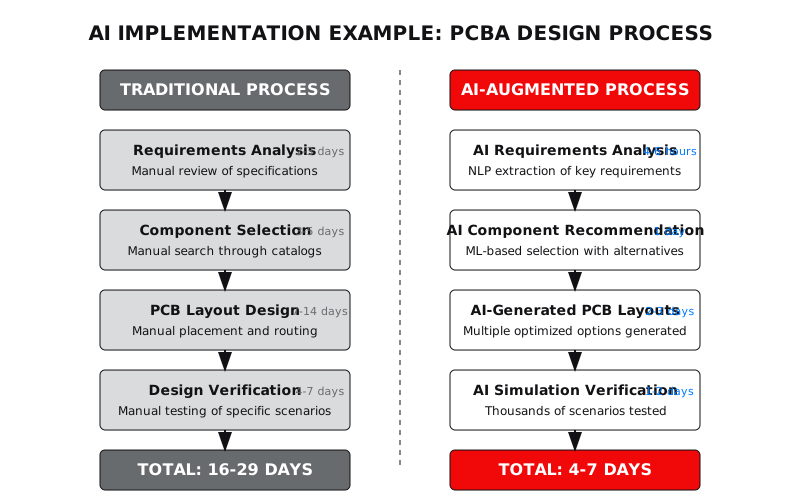
The implementation example above shows a real-world comparison between traditional and AI-augmented PCB design processes. This case study from one of our electrical engineering clients illustrates how AI tools compressed their design timeline by over 70% while improving quality outcomes.
Conclusion: Implementing AI in Your Electrical Engineering Workflow
The integration of AI tools into electrical engineering represents a fundamental shift in how design, testing, and implementation occur. These tools aren’t just automating existing processes – they’re enabling entirely new approaches that were previously impossible due to computational or time constraints.
The most successful organizations approach AI implementation strategically, focusing on:
- Clear problem identification – targeting specific challenges rather than implementing AI for its own sake
- Thoughtful tool selection – choosing tools that integrate well with existing workflows
- Deliberate change management – ensuring engineering teams understand and embrace new approaches
- Continuous evaluation – measuring results against established goals and making adjustments
At Empathy First Media, we’ve helped numerous engineering organizations implement AI tools that dramatically improve efficiency and outcomes. Our technical background combined with our AI expertise enables us to bridge the gap between cutting-edge technology and practical implementation.
Ready to explore how AI tools can transform your electrical engineering workflow? Schedule a discovery call with our team to discuss your specific challenges and opportunities.
Additional Resources for Electrical Engineering AI Implementation
For more information about implementing AI tools in electrical engineering, explore these resources:
- Google Search Central: Creating helpful, reliable, people-first content
- IEEE Spectrum: The New Age of Electrical Engineering
- Ansys AI Designer Documentation
- ABB Ability Technical Overview
- Keysight Technologies: AI in Electronic Design
About the Author
This article was prepared by the Empathy First Media team, led by Daniel Lynch, an experienced engineer and digital marketing expert with extensive experience in implementing AI solutions for technical teams. Our approach combines deep technical knowledge with practical implementation strategies to help organizations effectively adopt AI technologies.
