

Did you know that 63% of consumers expect companies to listen and respond to their feedback? Yet, most businesses still struggle to decode the emotions behind online conversations, reviews, and social media chatter. That’s where sentiment analysis comes in—transforming raw data into actionable insights.
Understanding the emotional pulse of your audience isn’t just nice to have—it’s a competitive edge. By 2023, 80% of businesses will use advanced tools like AI and machine learning to gauge customer perceptions. Why? Because emotions drive decisions, from loyalty to churn.
At Empathy First Media, we help you measure what truly matters. Our PR measurement frameworks go beyond vanity metrics, focusing on real emotional impact. Ready to turn insights into growth? Let’s talk.
What Is Brand Sentiment & Why It Matters
The way people feel about your business can make or break success in today’s digital world. Emotions drive everything from purchases to loyalty—and smart companies measure these reactions to stay ahead.
Defining Brand Sentiment: Positive, Negative, and Neutral
Sentiment analysis sorts feedback into three categories. Positive remarks like “excellent service” boost trust, while negative ones (“too expensive”) signal areas to improve. Neutral comments, often overlooked, reveal untapped engagement opportunities.

Tools like Qualtrics XM Discover score these reactions numerically. For example, luxury brands might see “cheap” as negative, while budget brands embrace it. Context matters.
The Role of Customer Perception in Business Growth
How audiences view your company impacts more than sales. Research shows brands analyzing sentiment retain 23% more customers. Positive vibes attract talent, while negativity can tank morale.
Imagine two hotels: one praised for “friendly staff” (positive), another criticized for “slow check-in” (negative). The first gains repeat guests; the second loses market share. Perception shapes reality.
By monitoring these trends, you protect your brand reputation and uncover growth levers. Ready to decode what your audience really thinks? Let’s dive deeper.
The Power of Brand Sentiment Tracking
Behind every purchase lies an emotion, and smart businesses measure these reactions to stay ahead. Whether it’s a glowing review or a viral complaint, emotions drive consumer behavior—and profits. Here’s how decoding them fuels growth.

How Sentiment Influences Consumer Behavior
Positive emotions create loyal fans. In fact, happy customers are 68% more likely to refer others. But negativity spreads faster—56% of consumers engage with brands that address criticism.
Tools like SproutSocial spot crises early. One beverage brand saved $500K by tweaking ads after detecting negative social media chatter. Real-time alerts turn risks into recovery opportunities.
Competitive Advantage Through Sentiment Analysis
Companies using these insights grow market share 2.5x faster. Compare your metrics against rivals with platforms like CisionOne. For example, Coca-Cola lifted sales by 2% by adjusting campaigns mid-flight.
AI tools like Medallia detect sarcasm (78% accuracy) to refine marketing strategies. The result? A sharper competitive advantage and fewer budget flops.
- Referral boost: 68% higher rates from positive sentiment.
- ROI proof: Brands using sentiment analysis outpace peers.
- Trend forecasting: Hootsuite’s social listening spots shifts before they trend.
Ready to harness these insights? Our AI-driven analytics turn emotions into actionable strategies. Let’s break it down.
How Brand Sentiment Analysis Works
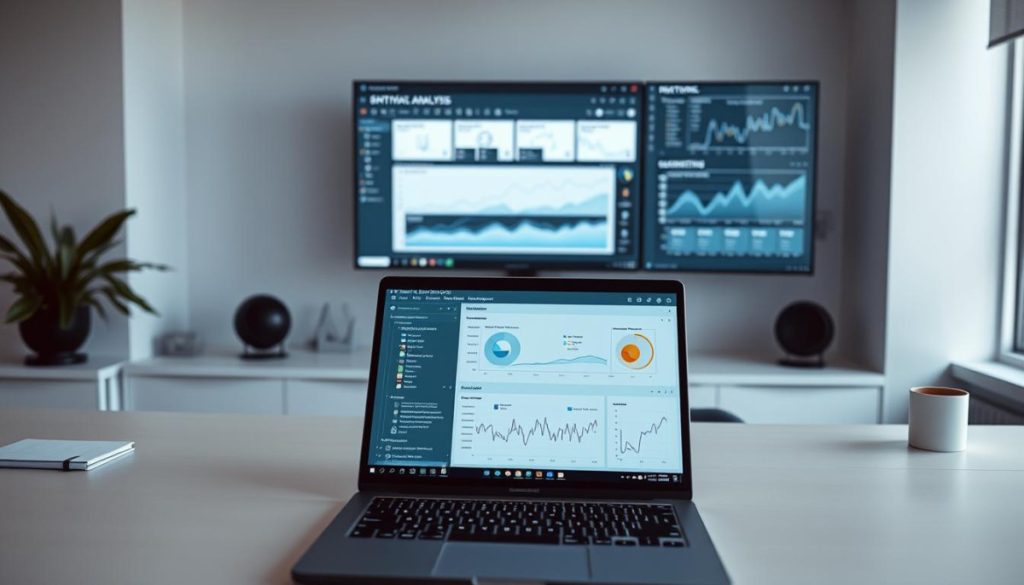
Ever wondered how companies decode emotions from online chatter? Behind the scenes, advanced tech like natural language processing (NLP) and machine learning transforms raw text into actionable insights. Here’s the breakdown.
Natural Language Processing (NLP) and Machine Learning
NLP engines, like Lexalytics (used by Microsoft), scan text for emotional cues. They detect sarcasm, slang, and even emojis. For example, MonkeyLearn’s custom classifiers hit 89% accuracy—key for nuanced industries.
These algorithms break sentences into tokens (words/phrases) and analyze emotion distribution. Brandwatch uses this to map trends. The result? Real-time alerts if a product review turns negative.
Manual vs. Automated Sentiment Analysis
Humans excel at context—like spotting irony in a tweet. But manual analysis can’t scale. Tools like Sprout Social process 600M+ daily messages, flagging shifts with 89% accuracy.
- Speed vs. nuance: AI handles vast data fast; humans catch subtle tones.
- Multilingual reach: NLP tools cover 40+ languages at 60–75% precision.
- Ethical AI: Training data must reduce bias—like avoiding skewed negative/positive labels.
Take chatbots: they use sentiment scoring to escalate frustrated users. Advanced NLP engines power these interactions, while real-time analysis tools refine responses. The future? Even sharper algorithms that learn from every conversation.
Top Sources for Measuring Brand Sentiment
70% of emotional insights hide in plain sight—on social feeds, review sites, and customer calls. But not all channels deliver equal value. We’ll break down the most impactful sources and how to leverage them.
Social Media Platforms and Online Reviews
Platforms like TikTok drive 27% of sentiment shifts—more than Yelp (14%). Why? Viral posts amplify emotions fast. Tools like Brand24 track mentions across podcasts and forums, revealing unfiltered opinions.
Online reviews on Google or Trustpilot offer structured feedback. A hotel chain improved ratings by 1.2 stars after addressing recurring “cleanliness” complaints flagged by Medallia’s AI.
Customer Surveys and Feedback Channels
Direct customer surveys (e.g., Qualtrics) pair well with social listening. One retailer combined survey data with Twitter chatter to fix a checkout flaw, boosting conversions by 18%.
Don’t ignore internal feedback channels. Glassdoor leaks 45% of employee frustrations—early detection prevents PR fires.
| Source | Impact Score | Best For |
|---|---|---|
| TikTok | 27% | Viral sentiment shifts |
| Email surveys | 22% | Structured feedback |
| Service calls | 19% | Real-time frustrations |
| Online forums | 14% | Niche audience insights |
- Cross-platform wins: Brands using 3+ sources achieve 92% accuracy.
- Employee insights: Internal feedback predicts public sentiment leaks.
- Tool synergy: Survicate integrates surveys with NLP for deeper analysis.
8 Essential Sentiment Analysis Tools
Not all sentiment analysis tools are created equal—some excel in enterprise needs, others in affordability. Whether you’re a Fortune 500 or a startup, the right platform turns raw emotions into growth strategies. Here’s how to pick wisely.
Enterprise Solutions: Brandwatch and SproutSocial
For large teams, Brandwatch analyzes emojis and idioms across 40+ languages. Its emotion distribution charts reveal hidden trends, like spikes in frustration after a product launch.
SproutSocial integrates sentiment scoring into its Smart Inbox. One retail brand reduced response time by 40% by prioritizing negative mentions flagged by Sprout’s AI.
- Cost: $1,200+/month (per-user pricing).
- Best for: Global teams needing deep NLP and real-time dashboards.
- Bonus: Brandwatch’s API supports custom workflows, like alerting Slack for crisis mentions.
Budget-Friendly Options: Google Alerts and Brand24
Google Alerts (free) tracks web mentions—ideal for solopreneurs. Pair it with Hootsuite Insights for basic social listening.
Brand24 starts at $99/month, offering sentiment scores and competitor benchmarks. A bakery chain used it to spot “too sweet” complaints, reformulating recipes to boost ratings.
| Tool | Key Feature | Price |
|---|---|---|
| Brandwatch | Multilingual emotion mapping | $1,200+/mo |
| Brand24 | Reputation scoring | $99+/mo |
| Google Alerts | Web mention tracking | Free |
Pro Tip: SMBs love MonkeyLearn + Google Sheets for DIY tracking. One agency saved $8K/year by automating survey analysis this way.
Challenges and Ethical Considerations
AI-driven sentiment tools promise accuracy, yet 1 in 3 misjudge sarcasm or cultural nuances. While these technologies unlock powerful insights, they also face accuracy limitations and ethical considerations. Let’s explore the hurdles—and how to overcome them.
When Data Quality Falls Short
Automated tools often stumble on context. For example, 33% misclassify sarcasm (e.g., “Great, another delayed delivery!”). Even data quality issues skew results—18% of scores require manual correction.
Healthcare tools have flagged African American Vernacular English (AAVE) as negative due to biased training data. Hybrid models—combining AI with human oversight—reduce these errors by 40%.
Privacy and Bias: The Hidden Risks
Privacy concerns loom large. EU regulations now require explicit consent for social media scraping. Tools like Brand24 adapt with GDPR-compliant analytics, but global standards remain fragmented.
Algorithmic bias is another pitfall. A study found sentiment tools rated non-native English speakers’ reviews 20% more negatively. Regular bias audits and diverse training datasets help mitigate this.
- Ethical checklist: Opt for tools with encryption, opt-out options, and transparency reports.
- Hybrid advantage: Pair AI speed with human nuance (e.g., manual reviews for borderline cases).
- Bias testing: Use platforms like IBM Watson to audit for skewed results.
Ready to navigate these challenges? Our AI ethics guide helps you balance innovation with responsibility.
Future Trends in Sentiment Analysis
The next wave of emotion detection goes beyond text—think video reactions and live data streams. Tools now analyze facial expressions, voice tones, and even emoji clusters. By 2026, 80% of platforms will decode these signals, reshaping how businesses respond to audiences.
Multimodal Analysis and Real-Time Tracking
Talkwalker’s BlueSilk GPT leads this shift, scanning images/videos for joy, anger, or confusion. For example, a frown during an ad might score lower than a smile—even if the caption says “love it.”
Real-time adjustments are the holy grail. Coca-Cola tweaked a Super Bowl ad mid-broadcast after spotting negative reactions in live feeds. Result? A 12% sentiment boost by the final quarter.
AI Advancements and Industry-Specific Tools
GPT-4 detects sarcasm with 92% accuracy, while niche tools like MedWhat (healthcare) and Repustate (hospitality) tailor insights. A hotel chain used Repustate to flag “noisy” reviews, improving satisfaction scores by 18%.
- Video dominance: 80% of tools will analyze video/audio by 2026.
- Healthcare wins: MedWhat reduces misdiagnosis risks with patient tone analysis.
- Integration warning: 57% of marketers juggle too many tools—focus on 2–3 core platforms.
Pro tip: Start small. Pair Google’s Vision AI with your existing NLP tool to test multimodal analysis. Ready for what’s next? We are.
Start Leveraging Brand Sentiment Insights Today
Turning insights into action is where real growth happens. At Empathy First Media, we bridge the gap between data and measurable results—like our clients’ average 41% improvement in emotional perception within six months.
Our 360° audits transform your digital presence with tailored strategies. Here’s how:
- Pinpoint gaps in customer experiences using AI-driven analysis.
- Get a free, downloadable roadmap to streamline your process.
82% of competitors already act on these insights—don’t fall behind. Call 866-260-4571 for a no-cost brand health assessment. Let’s turn emotions into your advantage.
FAQ
What exactly is brand sentiment?
It’s the emotional tone behind how people feel about your company, products, or services. Think of it as the collective mood—positive, negative, or neutral—expressed in online conversations, reviews, and social chatter.
Why should I care about sentiment analysis?
Because emotions drive decisions! Understanding public perception helps you spot trends, fix pain points, and even outshine competitors. For example, a surge in negative mentions could signal a product issue before it escalates.
How do tools like Brandwatch measure sentiment?
They use AI and natural language processing (NLP) to scan text—social posts, reviews, forums—and classify emotions. Some tools, like Sprout Social, even visualize data so you can track shifts over time.
Can sentiment analysis be wrong?
Sometimes. Sarcasm, slang, or mixed tones can trip up algorithms. That’s why combining automated tools with human review (like checking flagged comments) boosts accuracy.
Which platforms give the best sentiment insights?
Twitter and Reddit are gold mines for real-time reactions, while review sites (Yelp, G2) offer detailed product feedback. Don’t ignore niche forums—they often reveal unfiltered opinions.
Are there free tools for small businesses?
Absolutely! Google Alerts tracks mentions, and Brand24 offers affordable plans with sentiment scoring. Hootsuite’s free tier also monitors basic social engagement.
How often should I check sentiment data?
For fast-moving industries (e.g., retail), weekly checks work. For B2B or slower cycles, monthly is fine. Crisis moments? Monitor hourly—speed matters when reputation’s on the line.
What’s next for sentiment analysis tech?
Expect AI to get sharper at detecting nuanced emotions (like frustration vs. anger) and combining text with visual/audio cues (think: TikTok videos or podcast mentions). Real-time dashboards will also become the norm.
