

Interpersonal vs Intrapersonal Skills: Which Matters More in 2025?

Image Source: AI Generated
Your workforce spends over 70% of their workweek communicating across different channels. Yet 58% still wish they had better tools to be effective. This isn’t just about technology – it’s about skills.
The balance between people skills and self-management abilities has never been more crucial. Where interpersonal skills drive team success and client relationships, intrapersonal skills create the foundation for self-awareness and growth. These aren’t separate toolkits – they’re complementary systems that work together in your professional ecosystem.
Research confirms the impact: employees with stronger communication abilities are nearly 5 times more likely to report significant productivity increases. As remote work reshapes how teams connect and workplace dynamics evolve, understanding these skill sets becomes essential for success.
Smart professionals don’t choose one skill set over another. They recognize how each serves different purposes across their workday.
This guide examines the distinct value of both interpersonal and intrapersonal skills, helping you identify which might matter more for your specific role as we move toward 2025’s changing professional landscape. We’ll break down practical applications, development strategies, and how these abilities create measurable career advantages in different contexts.
Understanding the Core: Interpersonal vs Intrapersonal Skills

Image Source: Prezent
The prefix tells the whole story – "inter" happens between people, while "intra" occurs within yourself. This distinction isn’t just semantic – it’s the foundation for understanding two skill sets that power your professional success in completely different ways.
Definition of interpersonal skills with examples
Interpersonal skills are your tools for connecting with others. They determine how effectively you communicate, collaborate, and build relationships across all professional contexts. We see these abilities in action during team meetings, client presentations, and every workplace interaction that requires human connection.
These skills create measurable business value. Companies increasingly structure projects around collaborative teams rather than isolated specialists. Your ability to work effectively with others directly impacts project outcomes and workplace culture. Unlike technical capabilities that might become outdated, strong interpersonal skills remain valuable across industries and roles.
Key interpersonal skills include:
- Active listening: Fully focusing on speakers, understanding their message, and responding thoughtfully
- Effective communication: Expressing ideas clearly, both verbally and in writing
- Empathy: Understanding others’ perspectives and emotional experiences
- Conflict resolution: Addressing disagreements constructively without damaging relationships
- Teamwork: Collaborating productively with diverse colleagues
- Leadership: Guiding others toward shared goals
- Adaptability: Adjusting smoothly to new social dynamics and team structures
Professionals with strong people skills understand that communication goes beyond words. They recognize how body language, voice tone, and facial expressions shape meaning. This awareness helps them build rapport quickly and maintain productive relationships even during challenging situations.
Definition of intrapersonal skills with examples
Intrapersonal skills are your internal toolkit for self-management and growth. They involve the ongoing conversation you have with yourself – that internal dialog shaping how you process experiences and navigate challenges. While less visible than interpersonal abilities, these skills create the foundation for all external interactions.
At their core, intrapersonal skills center on self-regulation – your ability to stay focused on meaningful goals despite distractions or difficulties. This internal process encompasses not just thinking but also managing emotions and behaviors. It requires honest self-monitoring, mental flexibility, and emotional management.
Strong self-awareness empowers all other professional capabilities. We help clients understand that intrapersonal skills enable you to recognize your strengths, acknowledge limitations, and understand your emotional patterns. This self-knowledge builds the solid personal foundation necessary for effective external relationships.
Essential intrapersonal skills include:
- Self-awareness: Recognizing your behaviors and their impact
- Self-confidence: Trusting your abilities and judgment
- Resilience: Adjusting effectively to setbacks and challenges
- Optimism: Maintaining constructive attitudes during difficulties
- Focus: Managing attention and motivation toward meaningful outcomes
- Self-discipline: Following through on commitments even when motivation wavers
- Strategy adjustment: Modifying approaches when current methods aren’t working
The relationship between these skill sets isn’t just complementary – it’s foundational. Your interpersonal and intrapersonal abilities work together in every professional interaction. While people skills drive collaboration, they cannot exist without the internal framework of self-awareness, discipline, and adaptability. Simply put, what happens inside you makes possible everything you accomplish with others.
Key Differences Between Interpersonal and Intrapersonal Skills
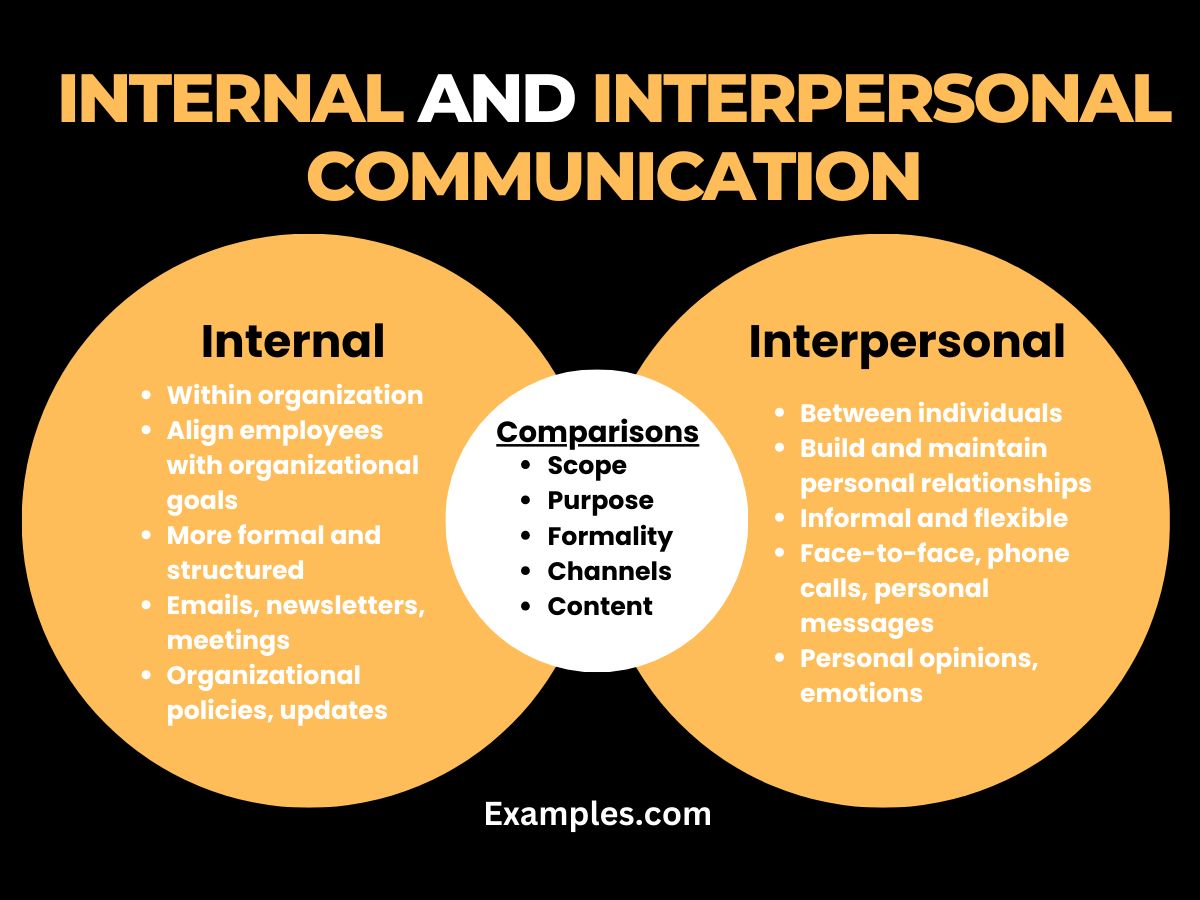
Image Source: Examples.com
The distinction between people skills and self-management skills reveals why successful professionals need both. These skill sets operate in different domains yet work together to create your complete professional toolkit.
Focus of interaction: external vs internal
What direction does your attention flow? This fundamental question reveals the primary difference between these skill types. Interpersonal skills direct your focus outward toward relationships and interactions with others, whereas intrapersonal skills primarily impact internal awareness and self-regulation [1].
Your interpersonal abilities shape how you connect with colleagues, clients, and teammates. They create the external framework for professional relationships and directly influence team dynamics. Your intrapersonal abilities, however, turn attention inward, building self-understanding and personal development.
We find that professionals with strong self-awareness establish a solid foundation for all external interactions. According to research, intrapersonal intelligence helps individuals handle emotions during uncertain situations, significantly improving stress management [1].
Communication style: interpersonal vs intrapersonal communication
The communication channels differ dramatically between these skill types. Interpersonal communication exchanges information and ideas between two or more people through verbal, non-verbal, or written methods [2]. Intrapersonal communication happens entirely within your own mind – that ongoing internal conversation shaping your thoughts and decisions [2].
Self-talk isn’t just random thinking – it’s the structured internal dialog you maintain with yourself throughout the day. Positive self-talk empowers and motivates, while negative patterns often become destructive and undermine confidence [2]. Visualization takes this process further, allowing you to create and manipulate mental scenarios to prepare for real-world situations [2].
We help clients understand that trusting relationships, shared values, and effective communication form the backbone of successful professional collaborations [3]. Effective communication requires both information exchange and facilitated dialog that engages all participants [3].
Feedback mechanisms: social cues vs self-reflection
How do you know if you’re getting it right? The answer varies completely based on which skill set you’re using.
With interpersonal communication, feedback arrives immediately from external sources – verbal responses, facial expressions, or written replies [2]. Others signal how your message lands, giving you real-time data about effectiveness.
Intrapersonal feedback works entirely differently, operating through self-reflection and personal evaluation [2]. This introspective process examines your thoughts, feelings, and actions to build deeper self-understanding [2].
Regular self-reflection builds stronger social-emotional skills, helping you better care for yourself and connect with others [4]. Education research shows even brief self-reflection exercises addressing emotional needs benefit both students and professionals in measurable ways [4].
- Interpersonal feedback: Immediate, external, observable
- Intrapersonal feedback: Self-generated, internal, reflective
The most effective professionals develop both systems simultaneously – they read external social cues while maintaining honest internal assessment [3]. This balanced approach creates a continuous improvement loop that strengthens both skill sets over time.
Real-World Applications in 2025 Workplaces

Image Source: Microsoft
The future workplace isn’t just changing – it’s already here. As teams adapt to new working models, the practical balance of interpersonal and intrapersonal skills directly impacts professional success across diverse environments.
Remote work and the rise of self-regulation
Remote work hasn’t just highlighted intrapersonal skills – it’s made them essential for daily success. Research shows that employees’ self-control positively influences their remote work self-efficacy, directly boosting overall effectiveness [5]. Without the structure of an office environment, your ability to self-regulate determines your productivity.
The shift to home-based work brought challenges most professionals weren’t prepared for, with many struggles stemming from underdeveloped self-control [5]. Creating physical and mental boundaries between work responsibilities and home life isn’t just helpful – it’s necessary for maintaining focus and preventing burnout [6].
Smart self-leadership strategies focused on time management and task prioritization now directly impact engagement levels in virtual work settings [7]. Remote success requires:
- Consistent self-discipline and internal motivation
- Independent goal-setting and follow-through
- Strategic personal workspace design and management
Team collaboration and the need for empathy
While self-management matters more than ever, interpersonal skills remain the cornerstone of team achievement. Empathy in workplace communication drives productive collaboration, especially during high-pressure situations and deadlines [8]. This isn’t just theory – 92% of hiring managers now rate soft skills as more important than technical capabilities [9].
McKinsey research revealed something striking: employees who experience greater inclusion in workplace communication are nearly 5 times more likely to report significant productivity increases [10]. This direct connection explains why empathetic leadership consistently produces superior team performance [11].
Leadership roles and the balance of both skill sets
The professional landscape is transforming rapidly. World Economic Forum projections show technology may displace 85 million jobs by 2025 while creating 97 million new, more adapted roles [9]. This shift demands leaders who balance both skill types.
Executive failure rates tell an important story: between 50-70% of leaders fail within 18 months of taking new roles – not from technical shortcomings but from ineffective interpersonal communication [9]. Meanwhile, 80-88% of workers across multiple countries recognize they need continuous skill development throughout their careers [12].
The most effective leaders in 2025 will understand that self-awareness forms the foundation for confident external communication [10]. This isn’t just complementary – it’s synergistic. Professionals who understand themselves deeply while connecting meaningfully with others create stronger collaboration, drive innovation, and build resilience in increasingly complex work environments.
Skill Development: How to Improve Both Sets Effectively

Image Source: Writing Commons
Professional growth doesn’t happen by accident. Deliberately practicing both interpersonal and intrapersonal skills creates a complete professional toolkit that drives workplace success. We’ll help you understand strategic approaches to building these complementary capabilities.
Building interpersonal skills through active listening and feedback
Active listening isn’t just hearing – it’s the cornerstone of meaningful workplace connection. This practice requires full engagement with speakers, genuine understanding of their message, and thoughtful response. The best listeners create environments where ideas flourish and team members feel valued.
We help clients develop active listening through these practical techniques:
- Create "wait time" before responding to prevent cutting off speakers mid-thought
- Mirror what you’ve heard by paraphrasing key points to confirm understanding
- Ask specific clarifying questions that demonstrate genuine interest and engagement
- Use open body language that signals receptiveness and attention
The business impact of listening goes beyond relationship building. Research confirms that employees perceive being listened to twice as strongly when leaders take appropriate action based on what they’ve heard. This action-oriented listening builds psychological safety and encourages continued sharing of innovative ideas.
Enhancing intrapersonal skills with journaling and mindfulness
Your internal dialog shapes everything from decision-making to emotional resilience. Journaling transforms this ongoing conversation from random thoughts into structured reflection. This practice shares several qualities with mindfulness: it sharpens focus, redirects attention inward, increases positive thinking, and reduces negative thought patterns.
Journaling offers practical advantages for busy professionals – it requires minimal resources, works anywhere, and benefits people at any career stage.
Mindfulness practice enhances your internal communication by making you more conscious of thought patterns and emotional responses. This heightened awareness allows you to identify triggers and self-limiting beliefs before they impact your external interactions. Regular mindfulness creates measurable benefits: reduced stress, improved sleep quality, and stronger emotional regulation – all essential components of professional effectiveness.
Self-reflection exercises develop your intrapersonal intelligence by examining fundamental questions: "What are my true strengths?" or "What work brings me genuine fulfillment?" This structured introspection builds self-understanding, which then strengthens external relationships through improved emotional management and more authentic communication.
The most successful professionals don’t view these practices as separate from "real work" – they recognize them as essential components of the daily routine that makes exceptional performance possible.
Which Matters More in 2025? A Role-Based Perspective

Image Source: Edstellar
The value of interpersonal versus intrapersonal skills isn’t a one-size-fits-all question. Your professional role and responsibilities largely determine which skill set delivers greater impact. Instead of declaring one universally superior, let’s examine how different positions require different balances of these complementary abilities.
Creative roles: intrapersonal skills for innovation
Creative work thrives on strong intrapersonal intelligence. With 85% of jobs in 2030 not yet invented, your internal skills provide the adaptability needed to navigate an uncertain future [13]. For creative professionals, self-awareness, emotional regulation, and metacognition (thinking about your thinking) serve as the engine room of innovation. When 23% of surveyed professionals identify creativity as pivotal for business competitiveness [14], these intrapersonal capabilities become particularly valuable in roles demanding original thinking.
Your ongoing internal dialog – that conversation you have with yourself throughout the day – directly fuels the creativity that helps organizations anticipate trends and develop unique solutions [1]. Creative professionals who maintain a growth mindset stay flexible and open to new information, finding innovative approaches to obstacles that would stump others [15].
Customer-facing roles: interpersonal skills for engagement
Customer-facing positions demand exceptional people skills. Empathy ranks among the most critical abilities for these roles, with nearly half of customers preferring to interact with representatives who understand their needs and concerns [16]. Your verbal communication, active listening, and conflict resolution skills directly impact customer satisfaction and build lasting loyalty [17].
Strong interpersonal abilities enable you to articulate ideas clearly, understand client requirements, and address inquiries with confidence [18]. These skills become essential business drivers as 77% of customers report greater loyalty to companies that deliver positive experiences [16].
Leadership roles: synergy of both skill types
Effective leadership in 2025 requires mastery across both domains. Emotional intelligence (EQ) has grown dramatically in importance, with 46% of respondents recognizing its significance for creating meaningful connections and managing diverse teams [14]. Leaders equipped with strong EQ inspire their teams, resolve conflicts effectively, and drive engagement that translates to measurable outcomes [19].
The most successful leaders develop what we call "integrated intelligence" – balancing technical proficiency with emotional awareness, driving innovation while maintaining human connection [19]. This isn’t just combining two separate skill sets; it’s creating something more powerful than either alone. Leaders who understand themselves deeply while connecting authentically with others build organizations designed for both performance and sustainability.
The question isn’t which matters more – it’s how effectively you can blend both skill types to meet your specific role requirements. We help professionals develop personalized development plans that target the exact balance needed for their current position and future aspirations.
Comparison Table
Understanding the distinct characteristics of interpersonal and intrapersonal skills helps clarify their unique contributions to your professional success. This side-by-side comparison highlights the essential differences between these complementary skill sets.
| Aspect | Interpersonal Skills | Intrapersonal Skills |
|---|---|---|
| Definition | Abilities used when interacting and communicating with others | Internal abilities for personal problem-solving and self-understanding |
| Focus | External relationships and interactions | Internal awareness and self-regulation |
| Key Components | – Active listening – Effective communication – Empathy – Conflict resolution – Teamwork – Leadership – Adaptability |
– Self-awareness – Self-confidence – Resilience – Optimism – Focus – Self-discipline – Strategy adjustment |
| Communication Style | Exchange of information between two or more people through verbal, non-verbal, or written channels | Internal dialog and self-talk |
| Feedback Mechanism | Immediate, external, observable through social cues | Self-generated, internal, reflective |
| Remote Work Impact | Essential for team collaboration and virtual communication | Critical for self-regulation and independent work management |
| Primary Application in 2025 | – Team collaboration – Customer engagement – Leadership roles |
– Remote work effectiveness – Creative innovation – Personal development |
| Development Methods | – Active listening practice – Feedback exercises – Social interaction |
– Journaling – Mindfulness practices – Self-reflection exercises |
We use this framework when helping clients assess their current capabilities and identify specific development opportunities. The most successful professionals don’t view these as competing skill sets but rather as complementary systems that work together to enhance overall effectiveness. Your specific role requirements will determine which aspects need more immediate attention in your personal development plan.
Conclusion
The conversation around interpersonal versus intrapersonal skills isn’t really a debate – it’s a false choice. Research confirms professionals need both skill sets, though their relative importance varies by role. Creative positions thrive on strong intrapersonal abilities that fuel innovation, while customer-facing roles demand exceptional people skills to build meaningful connections.
Remote work hasn’t just changed where we work – it’s shifted which skills matter most day-to-day. Self-regulation and internal motivation now directly impact independent productivity. Yet team collaboration and leadership still rely heavily on interpersonal abilities, especially as teams tackle increasingly complex challenges across digital spaces.
Smart automation saves time. But smart strategy turns that time into traction. Similarly, mastering both skill domains creates what we call "integrated intelligence" – the powerful combination of deep self-awareness with effective external communication. This balanced approach builds resilient professionals who adapt to changing workplace demands while creating meaningful team connections.
Your digital marketing ecosystem includes not just technical tools but also the human skills that make those tools effective. We find that professionals who actively develop both interpersonal and intrapersonal capabilities consistently outperform those who focus exclusively on one domain. They’re better equipped to thrive regardless of how technology and workplace dynamics evolve.
The future belongs to those who understand themselves deeply while connecting effectively with others. This isn’t just theory – it’s the practical reality of professional success in 2025 and beyond.
FAQs
Q1. How do interpersonal and intrapersonal skills differ in their focus?
Interpersonal skills focus on external interactions and relationships with others, while intrapersonal skills center on internal self-awareness and self-regulation.
Q2. Why are interpersonal skills crucial for career advancement?
Interpersonal skills, such as communication, teamwork, and empathy, are critical for building meaningful workplace relationships, enhancing team collaboration, and gaining a competitive edge in career progression.
Q3. How has remote work impacted the importance of intrapersonal skills?
Remote work has highlighted the significance of intrapersonal skills, particularly self-regulation and motivation, as they are essential for maintaining productivity and effectiveness when working independently.
Q4. What role do interpersonal skills play in customer-facing positions?
In customer-facing roles, interpersonal skills are vital for engaging clients, understanding their needs, and providing empathetic service, which directly impacts customer satisfaction and loyalty.
Q5. How can professionals develop both interpersonal and intrapersonal skills effectively?
Professionals can enhance interpersonal skills through active listening and feedback exercises, while intrapersonal skills can be improved through practices like journaling, mindfulness, and self-reflection.
References
[1] – https://www.betterup.com/blog/intrapersonal-skills
[2] – https://adrtimes.com/interpersonal-vs-intrapersonal-communication/
[3] – https://pmc.ncbi.nlm.nih.gov/articles/PMC6452942/
[4] – https://cpet.tc.columbia.edu/news-press/building-social-emotional-skills-through-self-reflection
[5] – https://pmc.ncbi.nlm.nih.gov/articles/PMC10619911/
[6] – https://pmc.ncbi.nlm.nih.gov/articles/PMC9029311/
[7] – https://www.researchgate.net/publication/380509329_Self-Leadership_in_a_Remote_Work_Environment_Emerging_Trends_and_Implications_for_Occupational_Well-Being
[8] – https://business.talkspace.com/articles/empathy-in-the-workplace
[9] – https://thunderbird.asu.edu/thought-leadership/insights/interpersonal-leadership-skills-are-essential-successful-leaders
[10] – https://www.edstellar.com/blog/interpersonal-vs-intrapersonal-skills
[11] – https://www.ccl.org/articles/leading-effectively-articles/empathy-in-the-workplace-a-tool-for-effective-leadership/
[12] – https://www.unleash.ai/learning-and-development/interpersonal-skills-essential-in-future-of-work/
[13] – https://www.verifyed.io/blog/intrapersonal-skills
[14] – https://www.linkedin.com/pulse/what-skills-critical-2025-castle-employment-agency-jagke
[15] – https://matterapp.com/blog/what-are-intrapersonal-skills-and-why-are-they-important
[16] – https://www.zendesk.com/blog/important-customer-service-skills/
[17] – https://www.linkedin.com/pulse/client-facing-jobs-skills-you-need-blu-digital-recruitment-bqcde
[18] – https://www.staffingthousandoaks.com/2025/01/22/the-importance-of-soft-skills-in-customer-service-hiring/
[19] – https://www.forbes.com/sites/karadennison/2024/12/26/top-leadership-skills-to-prioritize-and-develop-in-2025/
