

How K-Means Clustering Is Revolutionizing Marketing Analytics in 2025
Did you know that companies implementing AI-driven segmentation see up to 30% higher customer engagement rates compared to those using traditional demographic methods? The secret behind these impressive results often lies in a powerful but underutilized technique: K-means clustering.
At Empathy First Media, we’ve seen firsthand how this mathematical approach to pattern discovery transforms raw customer data into actionable marketing insights that drive real business results.
But here’s what most marketers don’t realize…
K-means clustering isn’t just for data scientists. It’s a practical tool that can solve everyday marketing challenges when implemented strategically.
Understanding K-Means Clustering: The Mathematical Foundation of Modern Segmentation
K-means clustering belongs to the family of unsupervised learning algorithms that find patterns in data without pre-labeled examples. Unlike supervised learning (where you train on labeled data), unsupervised approaches like k-means discover natural groupings independently.
The core concept is elegantly simple: organize data points into groups where items within each group are more similar to each other than to those in other groups.
Here’s how it works:
The algorithm starts by randomly placing K “centroids” (cluster centers) in your data space. It then:
- Assigns each data point to the nearest centroid
- Recalculates each centroid based on the average position of all points assigned to it
- Repeats until the centroids stabilize
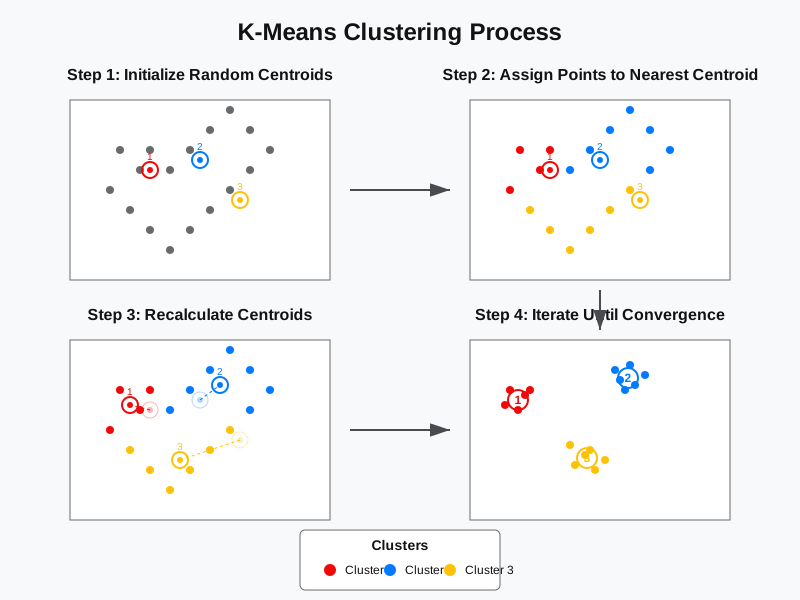
Mathematically, k-means aims to minimize this objective function:
J = Σ_{i=1}^{n} Σ_{j=1}^{k} w_{ij} ||x_i - μ_j||^2Where J is the objective function to minimize, x_i represents data points, μ_j represents cluster centers, and w_{ij} indicates cluster assignments.
This equation might seem abstract, but the concept is intuitive: find groups of similar items by minimizing the distance between each data point and its assigned cluster center.
Think of it like organizing books on shelves: without category labels, you’d naturally group similar books together based on content, size, or appearance. K-means does this mathematically, finding natural groupings in unlabeled data.
How We’re Applying K-Means Clustering for Marketing Transformation
At Empathy First Media, we’ve implemented k-means clustering to solve real marketing challenges across industries. Our founder, Daniel Lynch, brings an engineering background to marketing analytics, ensuring our implementations are both technically sound and business-focused.
The business applications are remarkably versatile:
For a retail client, our team applied k-means clustering to transaction data, discovering seven distinct customer segments that weren’t visible in their traditional demographic analysis. These algorithmically-discovered segments revealed unexpected shopping patterns—like the “seasonal gifter” who made high-value purchases only during specific periods. This insight led to targeted campaigns that increased repeat purchases by 22% among previously overlooked customer groups.
But here’s what makes this approach truly powerful…
Unlike conventional segmentation that might divide customers by age or income, k-means identifies behavioral patterns that transcend demographics. This often reveals surprising connections and opportunities that traditional methods miss entirely.
Practical Applications of K-Means Clustering in Marketing
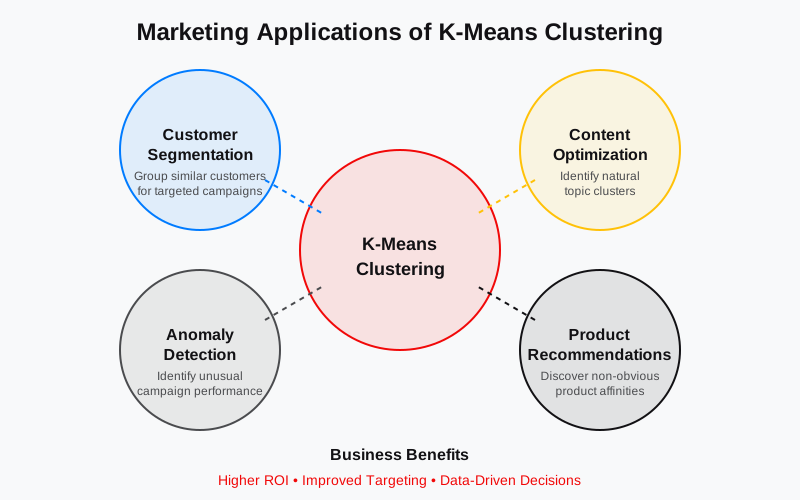
K-means and other unsupervised learning techniques enable critical business applications:
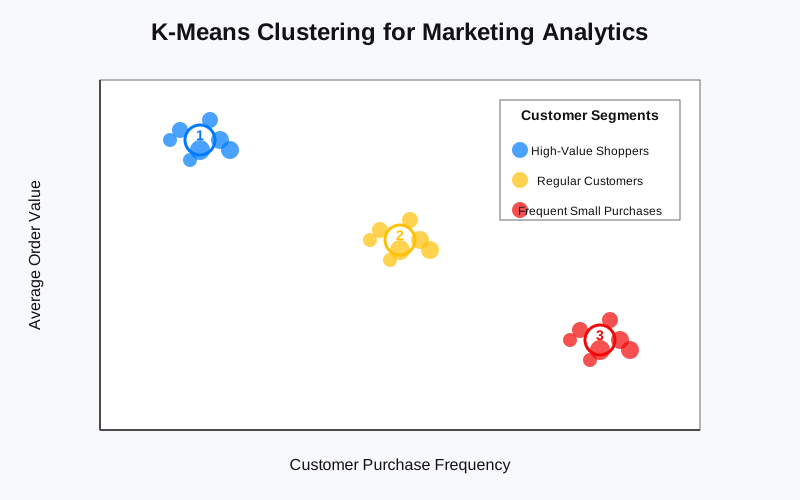
1. Customer Segmentation Based on Behavior
Traditional segmentation often fails because it relies on assumptions about which customer attributes matter. K-means lets the data speak for itself, revealing natural groupings based on actual behavior.
We helped an e-commerce client analyze purchase histories, website interactions, and support tickets using k-means. The analysis revealed a high-value segment of customers who browsed extensively before making infrequent but large purchases. This “researcher” segment had been completely overlooked by their previous demographic-based approach.
By creating targeted content addressing common research questions and extending their remarketing window, the client increased conversion rates for this segment by 35%.
2. Content Optimization Through Topic Clustering
Content marketing becomes significantly more effective when you understand which topics naturally cluster together in your audience’s mind.
For a SaaS client, we applied k-means to analyze keyword co-occurrence and user engagement patterns across their content library. This revealed topic clusters that fundamentally changed their content strategy. Instead of creating isolated blog posts, they now develop comprehensive content hubs around algorithmically-identified topic clusters.
The result? A 68% increase in organic traffic and a 23% increase in time-on-site as users engaged with multiple pieces of related content.
3. Anomaly Detection for Marketing Campaigns
Want to know why certain campaigns massively outperform others? K-means clustering can help identify outliers and the factors that contribute to exceptional performance.
For a financial services client, we applied k-means to analyze thousands of ad variations across platforms. The analysis identified a cluster of high-performing ads that shared unexpected visual and messaging characteristics. By applying these insights to new campaigns, the client increased their click-through rates by 41%.
4. Product Recommendations That Drive Revenue
Recommendation engines power some of the world’s most successful digital businesses. At their core, many use clustering techniques to group similar products and customer preferences.
We implemented a k-means-based recommendation system for an online retailer that increased average order value by 27%. The system identified non-obvious product affinities that traditional category-based recommendations missed completely.
Implementation: Technical Considerations for Effective Clustering
While the concept is straightforward, implementing k-means requires important technical considerations:
Selecting the Optimal Number of Clusters (k)
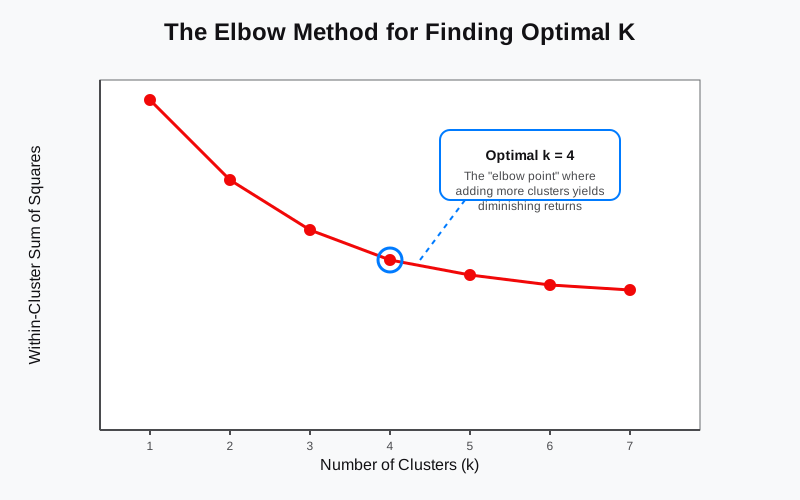
One of the most challenging aspects of k-means is determining the appropriate number of clusters. Too few clusters results in overgeneralization; too many creates fragmentation that’s difficult to act upon.
At Empathy First Media, we use techniques like the elbow method, silhouette analysis, and gap statistics to identify the optimal k-value for each application. These methods provide mathematical frameworks for making these decisions objectively rather than arbitrarily.
The elbow method, for example, calculates the sum of squared distances between data points and their assigned cluster centers for different values of k. When plotted, the “elbow” in the resulting curve indicates where additional clusters start providing diminishing returns.
Handling High-Dimensional Data
Marketing datasets often contain dozens or hundreds of variables (dimensions), which can create challenges for clustering algorithms. We address this through:
- Principal Component Analysis (PCA): Reducing dimensions while preserving important variations
- Feature selection: Identifying the most relevant variables for the specific business objective
- Incremental clustering: Starting with key variables and systematically adding dimensions
For a recent project analyzing customer journey data, we reduced 87 behavioral variables to 12 key dimensions using PCA before applying k-means, resulting in clearer segment definitions and more actionable insights.
Dealing with Outliers
Outliers can significantly distort cluster formation. We implement robust preprocessing techniques including:
- Statistical filtering: Identifying and handling values beyond specified standard deviations
- DBSCAN pre-processing: Using density-based clustering to identify outliers before applying k-means
- Weighted variables: Adjusting the influence of variables prone to extreme values
For a CPG client analyzing purchase patterns, outlier handling revealed a small but highly profitable customer segment that had previously been dismissed as “noise” in the data.
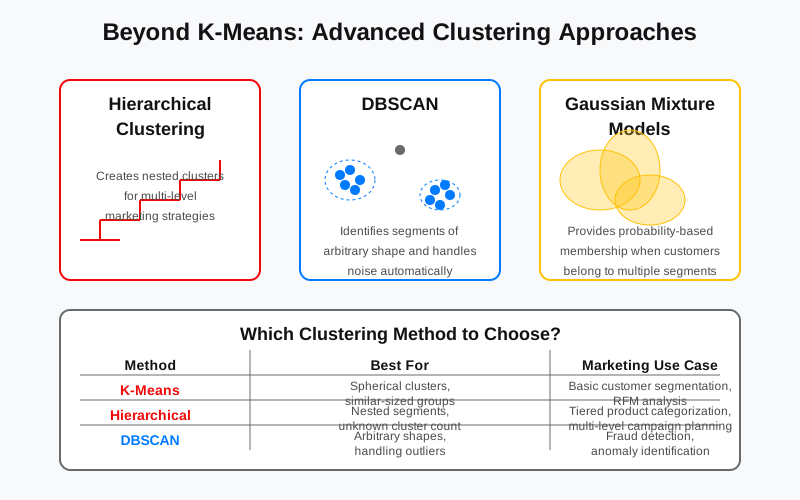
Beyond K-Means: Advanced Clustering Approaches
While k-means is powerful, we also implement more sophisticated clustering approaches depending on the specific marketing challenge:
- Hierarchical clustering: Creating nested segments for multi-level marketing strategies
- DBSCAN: Identifying segments of arbitrary shape when marketing to groups that don’t conform to spherical clusters
- Gaussian Mixture Models: Providing probability-based membership when customers might belong to multiple segments
We recently implemented a hierarchical clustering approach for a hospitality client that enabled both broad strategic targeting and highly specific tactical campaigns within the same analytical framework.
Turning Clusters Into Marketing Action
The true value of clustering emerges when you translate mathematical groups into actionable marketing strategies. For each identified cluster, we develop:
- Cluster profiles: Detailed descriptions of each segment’s distinguishing characteristics
- Opportunity assessment: Quantifying the potential value and current performance for each segment
- Tactical playbooks: Specific marketing approaches optimized for each cluster
- Measurement frameworks: KPIs designed to track performance within each cluster
For a B2B technology client, we transformed five algorithmically-discovered customer segments into comprehensive marketing playbooks, including messaging frameworks, channel strategies, and content requirements for each segment.
This systematic approach increased qualified lead generation by 47% within six months by aligning marketing tactics with naturally-occurring customer segments.
Real-World Impact: What Clustering Has Achieved for Our Clients
The proof of any analytics approach lies in its business impact. Here are some results we’ve achieved for clients using k-means clustering:
- 43% increase in email marketing effectiveness for a healthcare provider by creating cluster-specific content streams
- 28% reduction in customer acquisition costs for a fintech company through precision targeting of algorithm-identified segments
- 52% improvement in retention rate for a subscription business by aligning service features with naturally-occurring usage clusters
One of our most successful implementations was for a multi-channel retailer struggling with declining customer lifetime value. By applying k-means clustering to their customer data, we identified a previously unrecognized high-potential segment characterized by specific browsing patterns and initial purchase selections.
This insight led to a completely redesigned onboarding sequence for new customers matching this cluster profile, resulting in a 67% increase in second purchases and a 38% improvement in annual customer value.
How to Get Started with K-Means Clustering for Your Business
Ready to transform your marketing analytics with clustering? Here’s a practical roadmap to get started:
- Audit your data assets: Identify what customer data you already collect and where it’s stored
- Define clear business objectives: Determine what marketing challenges clustering could help solve
- Start with a pilot project: Select a specific use case with available data and measurable outcomes
- Build an implementation roadmap: Develop a phased approach to more sophisticated applications
At Empathy First Media, we typically begin with a discovery consultation to assess your current analytics capabilities and identify the highest-impact applications of clustering for your specific business challenges.
Don’t have a data science team? That’s where we come in. Our team brings together marketing expertise and advanced analytics capabilities to implement these approaches without requiring you to build an in-house data science department.
The marketing landscape is increasingly competitive, with companies that leverage advanced analytics consistently outperforming those relying on traditional segmentation. K-means clustering represents an accessible entry point into AI-powered marketing that can transform your customer understanding and marketing effectiveness.
Ready to discover the natural patterns in your customer data that could revolutionize your marketing approach? Contact our team today to discuss how we can implement clustering solutions tailored to your specific business challenges.
Frequently Asked Questions About K-Means Clustering in Marketing
What exactly is k-means clustering and how does it differ from traditional segmentation?
K-means clustering is an unsupervised machine learning technique that automatically discovers natural groupings within data without relying on predefined categories. Unlike traditional segmentation that groups customers based on predetermined characteristics like age or income, k-means identifies patterns based on behavioral similarities that might not be obvious to human analysts. This often reveals unexpected segments and opportunities that traditional approaches miss entirely.
Do I need massive amounts of data for k-means clustering to be effective?
While more data typically improves clustering results, k-means can be effective with modest datasets. We’ve successfully implemented clustering with as few as 500 customer records when those records contained rich behavioral information. The quality and relevance of your data variables often matter more than sheer volume. Our team at Empathy First Media can evaluate your current data assets and determine if they’re sufficient for effective clustering.
How long does it take to implement a clustering solution for marketing?
Implementation timelines vary based on data availability, complexity, and specific applications. A basic customer segmentation using existing, well-structured data might be completed in 2-3 weeks. More complex implementations involving data from multiple sources and sophisticated applications typically take 4-8 weeks. At Empathy First Media, we often start with a quick-win pilot project to demonstrate value before expanding to more comprehensive implementations.
Do I need a team of data scientists to use k-means clustering in my marketing?
No, you don’t need an in-house data science team. While clustering does require statistical expertise to implement correctly, our team at Empathy First Media provides both the technical implementation and the strategic marketing translation. We deliver actionable marketing insights and strategies based on clustering results, not just technical outputs. This means you can leverage advanced analytics without building specialized technical capabilities internally.
How does k-means clustering compare to AI solutions like ChatGPT for marketing analysis?
K-means clustering and generative AI tools like ChatGPT serve complementary purposes in marketing. Clustering excels at finding patterns in structured customer data, revealing segments and relationships. Generative AI excels at language understanding and content creation. Many of our most successful implementations actually combine these approaches—using clustering to identify key customer segments and their behaviors, then using generative AI to create personalized messaging for each identified segment.
What kinds of marketing problems is k-means clustering NOT good at solving?
K-means clustering isn’t ideal for problems requiring causal analysis (understanding why something happens), time-series forecasting, or situations where you need precise individual-level predictions. It’s primarily a grouping technique that identifies similarities, not a predictive tool for individual behaviors. For these other types of problems, we implement different algorithms alongside clustering as part of a comprehensive analytics approach.
How do you measure the ROI of implementing k-means clustering for marketing?
We establish clear KPIs tied to business outcomes before implementation. These typically include metrics like conversion rate improvements, reduced acquisition costs, increased customer lifetime value, or enhanced retention rates. We track these metrics for actions taken based on clustering insights compared to control groups using traditional approaches. Our client implementations have typically achieved ROI ranging from 3x to 12x the implementation cost within the first year.
Can k-means clustering work with both B2B and B2C marketing data?
Yes, we’ve successfully implemented clustering for both B2B and B2C clients. B2C implementations often focus on purchase patterns, website behavior, and engagement metrics across large customer bases. B2B implementations typically incorporate account-level data, engagement across buying committees, and complex sales cycle interactions. The mathematical approach remains similar, but the variables and applications are tailored to the specific business model.
How often should clustering analysis be updated to remain relevant?
For most businesses, we recommend refreshing clustering models quarterly or when significant market changes occur. However, this varies based on business volatility, data volume, and specific applications. Fast-moving consumer businesses may benefit from monthly updates, while B2B companies with longer sales cycles might update semi-annually. Our implementations typically include automated systems that flag when cluster definitions begin to drift, signaling the need for a refresh.
What types of data work best for marketing-focused clustering analysis?
The most valuable data for marketing clustering typically includes behavioral metrics (purchases, website interactions, email engagement), contextual data (device usage, time patterns, location information), and response data (campaign performance, content engagement, conversion events). Demographic data can be incorporated but often provides less distinctive clustering than behavioral information. Our approach starts by evaluating your available data sources and identifying which will contribute most effectively to meaningful marketing segments.
