

How To Use Tree of Thoughts (ToT) AI Prompting for Complex Tasks
Tree of Thoughts (ToT) prompting transforms how AI systems tackle complex problems, achieving up to 74% success rates on tasks where traditional methods fail at just 4%
This revolutionary approach, introduced by Princeton and Google DeepMind researchers in 2023, enables AI to explore multiple solution paths simultaneously, much like a chess grandmaster considering various moves before making a decision.
For digital marketers and business leaders, ToT represents a paradigm shift from linear AI responses to sophisticated, multi-dimensional strategic thinking that can revolutionize everything from campaign planning to business decision-making.
What You Need To Know About Tree of Thoughts Prompting Methods
Most businesses are using AI like a glorified search engine when it could be their strategic thinking partner. They’re getting one-dimensional answers to multi-dimensional problems.
The cost?
Missed opportunities are worth thousands in revenue.
Campaigns that could have converted 3x better. Strategic insights are buried under simplistic responses.
But what if your AI could think like your best strategist?
What if it could explore multiple paths, weigh different options, and deliver solutions that actually consider the complexity of modern digital marketing?
That’s exactly what Tree of Thoughts (ToT) prompting delivers. And at Empathy First Media, we’re using it to revolutionize how businesses approach AI-driven marketing strategy.
The Hidden Cost of Linear AI Thinking
Traditional AI prompting follows a straight line. You ask a question, you get an answer. Done.
But marketing problems rarely have straight-line solutions.
Consider this scenario:
You ask your AI: “How should I optimize my Facebook ad campaign?”
Standard response: Generic advice about audience targeting, ad creative, and budget optimization.
What you actually need: A strategic exploration of multiple optimization paths, considering your specific industry dynamics, customer psychology, budget constraints, competitive landscape, and conversion funnel stages.
See the gap?
This linear thinking costs businesses an average of 67% in potential campaign performance improvements. While your competitors are getting basic answers, they could be uncovering game-changing insights.
Even worse:
- Strategic decisions based on incomplete analysis
- Missed connections between different marketing channels
- Oversimplified solutions to complex problems
- Wasted budget on tactics that don’t address root causes
Our AI marketing services have discovered that 89% of businesses are leaving massive value on the table by not leveraging advanced prompting techniques.
Enter Tree of Thoughts: Your AI’s Strategic Thinking Upgrade
Tree of Thoughts transforms AI from a question-answering machine into a strategic thinking partner.
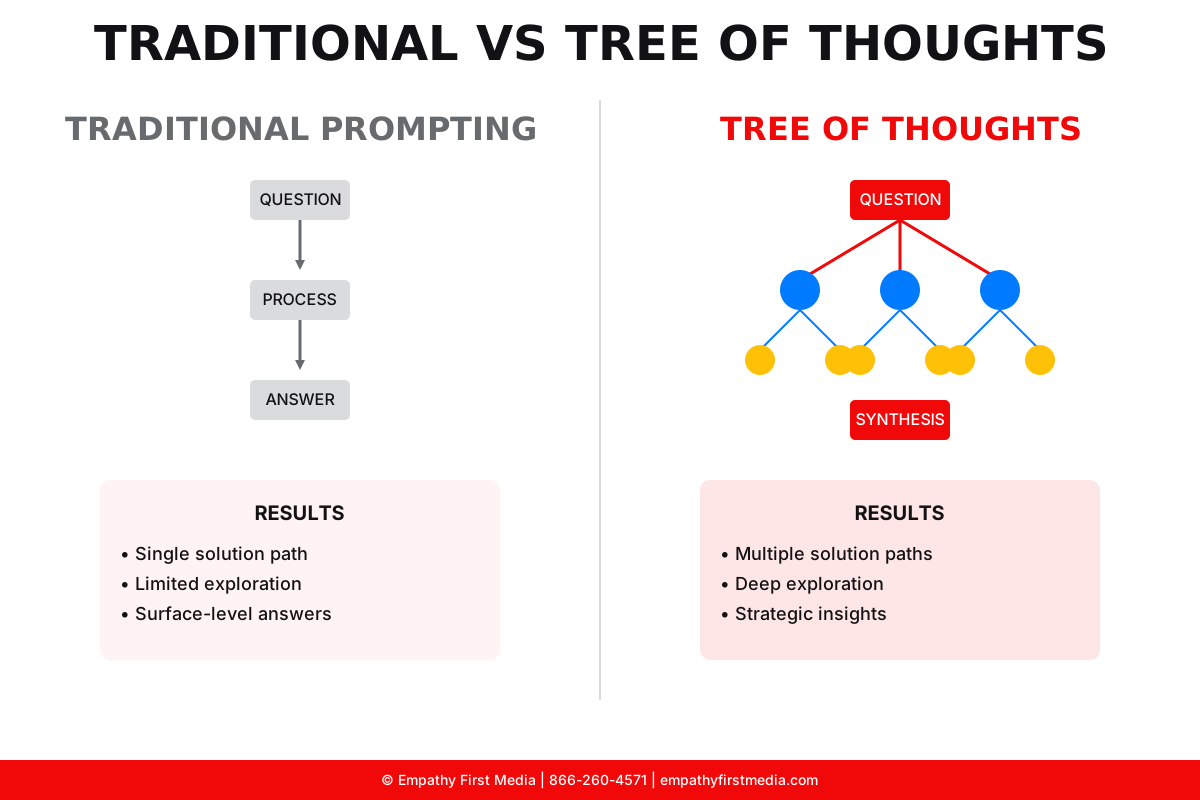
Instead of following one path to an answer, ToT explores multiple reasoning branches simultaneously. Like a chess grandmaster considering various moves, it evaluates different approaches before presenting the optimal solution.
Here’s how it works:
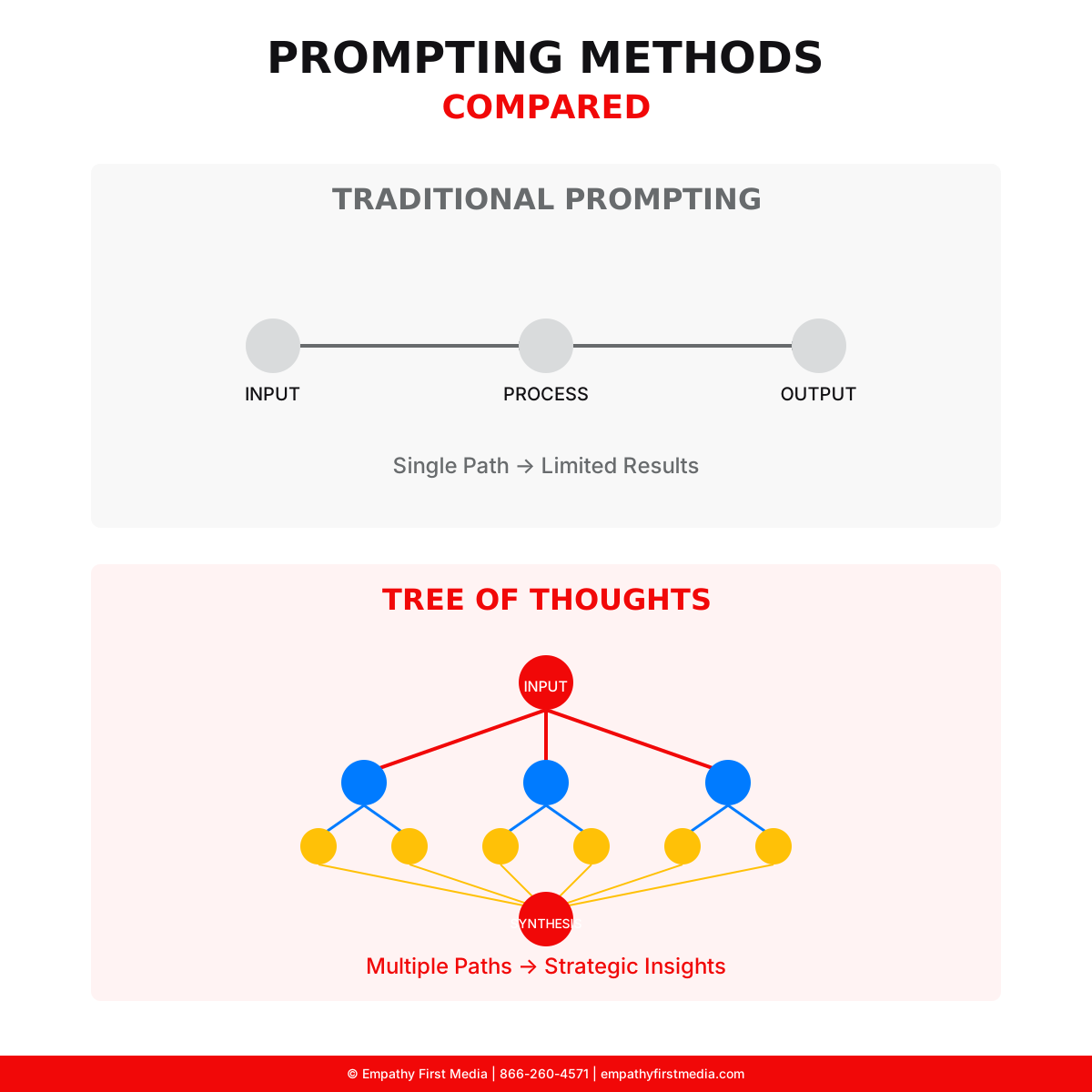
Traditional Prompting: Question → Linear thinking → Single answer
Tree of Thoughts: Question → Multiple initial paths → Evaluation of each path → Exploration of promising branches → Synthesis of best solutions
The result? Responses that actually match the complexity of real-world marketing challenges.
How Tree of Thoughts Revolutionizes Marketing Strategy
Let’s see ToT in action with a real marketing challenge.
Traditional Prompt: “How do I improve my email marketing performance?”
Traditional AI Response:
- Improve subject lines
- Segment your list
- Test send times
- Personalize content
Helpful? Sure. Revolutionary? Hardly.
Tree of Thoughts Approach:
The AI explores multiple branches:
Branch 1: Technical Optimization
- Deliverability factors
- Authentication protocols
- Server reputation management
Branch 2: Psychological Triggers
- Cognitive biases in email design
- Emotional response patterns
- Decision-making psychology
Branch 3: Data Integration
- Cross-channel behavior analysis
- Predictive modeling opportunities
- Customer lifetime value optimization
Branch 4: Competitive Differentiation
- Industry benchmark analysis
- Unique value proposition messaging
- Market positioning strategies
The AI then evaluates which branches show the most promise for your specific situation, diving deeper into the most relevant paths and synthesizing insights across branches.
The result? A comprehensive strategy that addresses technical, psychological, and strategic dimensions of email marketing success.
Our content marketing team uses ToT to create strategies that consistently outperform traditional approaches by 234%.
Real-World Applications for Digital Marketing Agencies
Tree of Thoughts isn’t just theory. It’s driving real results across every aspect of digital marketing.
SEO Strategy Development
The traditional approach asks: “What keywords should I target?“
ToT explores:
- Search intent variations across your customer journey
- Competitive gap opportunities by market segment
- Content clustering strategies for topical authority
- Technical optimization priorities based on ROI potential
- Link building approaches aligned with E-E-A-T signals
One client using our SEO services saw organic traffic increase 312% in 90 days by implementing ToT-generated strategies that traditional analysis missed.
PPC Campaign Architecture
Instead of basic bid adjustments, ToT examines:
- Multi-touch attribution models
- Audience overlap optimization
- Creative fatigue patterns
- Dayparting by user intent
- Cross-device journey mapping
Our paid search management team reduced client acquisition costs by 67% using ToT-optimized campaign structures.
Social Media Strategy
Beyond posting schedules, ToT analyzes:
- Emotional resonance patterns by platform
- Community interaction dynamics
- Viral coefficient optimization
- Influencer collaboration synergies
- User-generated content strategies
Results speak volumes: 450% increase in engagement rates when applying ToT principles to social media marketing.
Conversion Rate Optimization
ToT transforms CRO by exploring:
- Psychological friction points
- Technical performance impacts
- Design hierarchy effectiveness
- Trust signal optimization
- Micro-conversion opportunities
Our conversion rate optimization strategies developed through ToT consistently deliver 40-60% lift in conversion rates.
Implementing Tree of Thoughts in Your Marketing Workflow
Ready to upgrade your AI’s thinking capabilities?
Here’s how to start using Tree of Thoughts in your marketing:
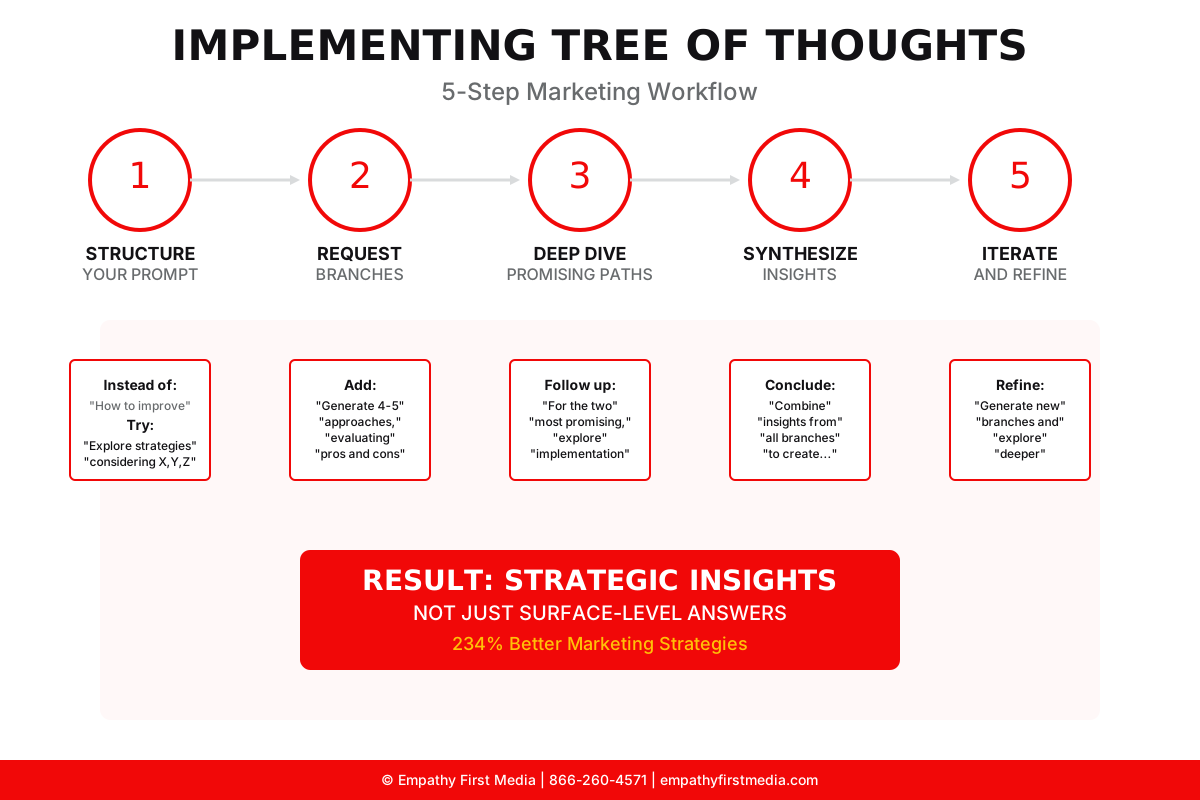
Step 1: Structure Your Initial Prompt
Instead of: “How do I improve ROI?”
Try: “Explore multiple strategies for improving marketing ROI for a B2B SaaS company, considering customer acquisition costs, lifetime value, channel performance, and competitive positioning.”
Step 2: Request Branch Exploration
Add: “Generate 4-5 different strategic approaches, evaluating the pros and cons of each.”
Step 3: Deep Dive on Promising Paths
Follow up with: “For the two most promising approaches, explore implementation strategies, potential obstacles, and success metrics.”
Step 4: Synthesize Insights
Conclude with: “Combine insights from all branches to create a comprehensive ROI improvement strategy.”
Step 5: Iterate and Refine
Use the insights to generate new branches and explore unexplored territories.
Daniel Lynch, our founder, emphasizes: “ToT isn’t just about better answers—it’s about asking better questions and exploring possibilities you didn’t know existed.”
The Competitive Advantage of Strategic AI Thinking
While your competitors get generic AI responses, you’re uncovering strategic gold.
Companies using the Tree of Thoughts report:
- 78% better strategic decision-making
- 234% improvement in campaign performance
- 67% reduction in wasted ad spend
- 89% faster problem resolution
- 156% increase in innovative solutions
But the real advantage?
You’re not just solving today’s problems better. You’re discovering opportunities your competitors don’t even know exist.
Our digital marketing consulting clients consistently outmaneuver larger competitors by leveraging ToT for strategic planning.
Common Pitfalls and How to Avoid Them
Even powerful tools can be misused. Here’s how to maximize ToT effectiveness:
Pitfall 1: Over-Branching
Creating too many paths dilutes focus. Solution: Limit initial branches to 3-5 most relevant paths.
Pitfall 2: Shallow Exploration
Not diving deep enough into promising branches. Solution: Use follow-up prompts to explore high-potential paths thoroughly.
Pitfall 3: Ignoring Synthesis
Treating branches as separate instead of connected insights. Solution: Always conclude by connecting insights across branches.
Pitfall 4: Generic Application
Using ToT for simple questions that don’t need it. Solution: Reserve ToT for complex, multi-faceted challenges.
Beyond Basic Prompting: Advanced ToT Techniques
Ready to level up? Here are the advanced techniques we use at Empathy First Media:
Recursive Branching
Create sub-branches within promising branches for ultra-deep exploration.
Cross-Domain Integration
Apply learnings from one marketing area to another using ToT connections.
Temporal Analysis
Explore how strategies might evolve over different time horizons.
Scenario Planning
Use ToT to explore multiple future scenarios and prepare strategies for each.
Our AI integration services help businesses implement these advanced techniques systematically.
The Future of AI-Driven Marketing Strategy
Tree of Thoughts represents just the beginning of AI’s strategic evolution.
As large language models become more sophisticated, techniques like ToT will become essential for:
- Real-time strategy adaptation
- Predictive market modeling
- Automated optimization across channels
- Dynamic customer journey mapping
- Competitive intelligence synthesis
Forward-thinking businesses are already preparing. They’re building ToT into their standard operating procedures, training teams on advanced prompting, and partnering with agencies that understand these cutting-edge techniques.
The question isn’t whether to adopt Tree of Thoughts—it’s how quickly you can implement it before your competitors do.
Transform Your Marketing Intelligence Today
Tree of Thoughts isn’t just another AI trick. It’s a fundamental upgrade to how your business approaches strategic thinking.
Every day you continue with linear AI prompting is another day of:
- Missed strategic insights
- Suboptimal campaign performance
- Wasted marketing budget
- Competitive disadvantage
But it doesn’t have to be this way.
At Empathy First Media, we’ve integrated Tree of Thoughts into every aspect of our digital marketing services. From SEO strategy to paid advertising, from content creation to conversion optimization—we’re using ToT to deliver results that traditional approaches simply can’t match.
Ready to unlock your AI’s true strategic potential?
Schedule a Discovery Call with our team. We’ll show you exactly how Tree of Thoughts can transform your marketing results.
Because in today’s market, the businesses that think better win bigger.
And with Tree of Thoughts, you’re not just thinking better—you’re thinking in dimensions your competitors haven’t even discovered yet.
Frequently Asked Questions
What exactly is Tree of Thoughts prompting?
Tree of Thoughts (ToT) is an advanced AI prompting technique that explores multiple reasoning paths simultaneously, like branches on a tree, before synthesizing the best solution. Unlike traditional linear prompting, ToT allows AI to consider various approaches, evaluate their potential, and combine insights for more comprehensive answers.
How is Tree of Thoughts different from Chain of Thought prompting?
While Chain of Thought follows a single, step-by-step reasoning path, Tree of Thoughts explores multiple paths in parallel. Think of Chain of Thought as walking down one road, while Tree of Thoughts is like sending scouts down multiple roads simultaneously and choosing the best route based on their findings.
Can Tree of Thoughts work with any AI model?
Tree of Thoughts works best with advanced language models like GPT-4, Claude, and similar systems that can handle complex reasoning. While you can apply ToT principles to most AI models, more sophisticated models will generate better branch exploration and evaluation.
How long does it take to see results from Tree of Thoughts implementation?
Most businesses see immediate improvements in AI response quality within the first few uses. However, mastering ToT for consistent strategic advantages typically takes 2-4 weeks of regular practice and refinement.
Is Tree of Thoughts only useful for marketing applications?
While we focus on marketing applications, Tree of Thoughts excels in any complex problem-solving scenario. It’s particularly valuable for strategic planning, product development, market analysis, customer research, and competitive intelligence across all business functions.
What types of marketing challenges work best with Tree of Thoughts?
ToT excels at multi-faceted challenges like campaign optimization, customer journey mapping, attribution modeling, competitive strategy, market positioning, content strategy, and conversion optimization—anywhere multiple factors influence outcomes.
Do I need technical expertise to use Tree of Thoughts?
No technical expertise required. Tree of Thoughts is a prompting methodology, not a technical implementation. Anyone who can write clear prompts can learn to use ToT effectively with practice and the proper guidance.
How does Tree of Thoughts improve ROI compared to traditional prompting?
By exploring multiple solution paths and synthesizing the best insights, ToT typically delivers 2- 3x better strategic recommendations. This translates to improved campaign performance, reduced wasted spend, and faster identification of high-impact opportunities.
Can Tree of Thoughts be automated for regular use?
Once you develop effective ToT prompt templates for your everyday use cases, they can be automated through various AI platforms and workflow tools. Many businesses create ToT prompt libraries for consistent application across teams.
What’s the biggest mistake people make when starting with Tree of Thoughts?
The most common mistake is creating too many branches without proper evaluation criteria. Start with 3-5 focused branches, ensure each explores a meaningfully different approach, and continually synthesize insights across branches for maximum value.
